
The5ers Review 

The5ers presents itself as a proprietary trading company offering traders access to funded accounts worth tens or even hundreds of thousands of dollars. The marketing is straightforward: pay for a trading program, meet the required targets, follow the rules, and receive a share of the profits.

However, there is an important difference between the marketing promise and what traders actually receive.

The5ers is not a conventional regulated forex broker. Traders do not receive the advertised capital as their own money. Trading under the programs is conducted in a simulated environment, while access to payouts depends on compliance with the company’s internal rules.

For traders considering whether The5ers is safe, these details deserve serious attention. Based on the structure of the service, the complaints surrounding payouts and the lack of conventional financial regulation, The5ers should be treated as a high-risk prop trading operation and, in our assessment, as a potential scam.

What Is The5ers?

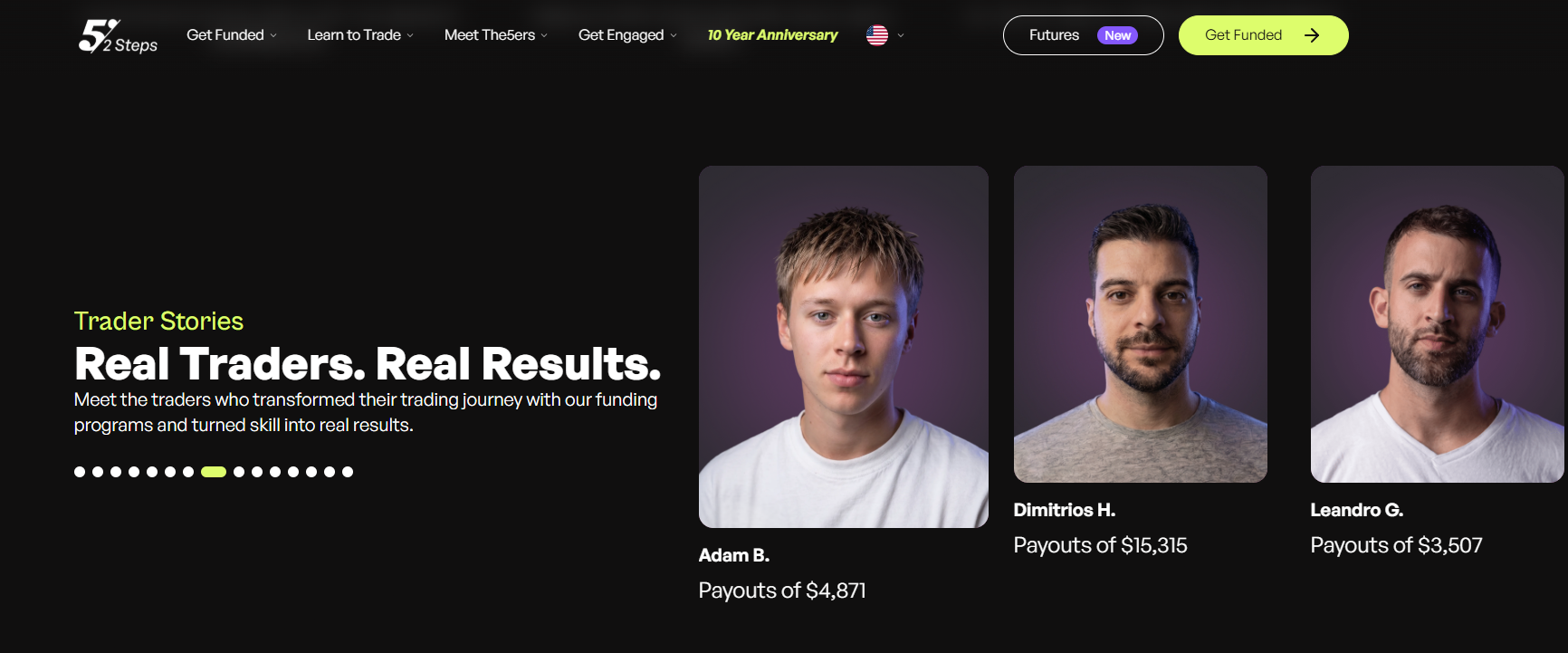
The5ers is a proprietary trading company that has operated since 2016. It offers several trading programs, including High Stakes, Bootcamp and Hyper Growth.

The basic model is similar to other prop firms. A trader pays a fee to enter an evaluation program. The trader must then achieve specific profit targets without exceeding the company’s drawdown and risk limits.

Successful traders may eventually receive a funded account and become eligible for profit withdrawals.

The problem is that the advertised account size should not be interpreted as money deposited for the trader.

The5ers states that its trading environment is simulated. Therefore, an account showing $100,000 or another large balance does not mean that $100,000 has been transferred to the trader or placed under the trader’s ownership.

This is an important distinction that can easily get lost in aggressive funded-account marketing.

The5ers Is Not a Regulated Forex Broker

One of the biggest red flags is the company’s regulatory status.

The5ers should not be confused with a licensed forex broker. It operates as a proprietary trading company rather than a conventional financial institution holding customer deposits.

This means that a trader does not receive the same type of regulatory protection that would normally apply when dealing with a licensed broker.

The existence of a registered corporate entity in Israel or the United Kingdom does not automatically mean that the company is authorized to provide regulated investment or brokerage services.

For a trader, this distinction matters because the relationship is primarily governed by The5ers’ own terms and trading rules.

You Pay for an Evaluation

The marketing surrounding funded accounts can make the arrangement sound like an investment by the company in the trader.

That is not what happens.

The trader pays a fee to participate in an evaluation program. The trader then has to prove that they can generate profits while staying within the company’s rules.

If the evaluation fails, the trader loses the program fee and generally has to purchase another program if they want to try again.

This creates a business model where large numbers of traders can generate revenue through evaluation fees, while only a smaller percentage reach the payout stage.

There is nothing inherently illegal about this model. The concern is whether the conditions under which successful traders receive their money are sufficiently transparent and consistently applied.

The Trading Rules Are Strict

The5ers imposes detailed restrictions on trading activity.

Traders have to comply with maximum drawdown limits, daily loss restrictions and other risk-management requirements. The company also prohibits certain trading practices that it considers abusive or inconsistent with its model.

Again, risk limits are normal in proprietary trading.
The problem arises when a trader can be profitable overall but still lose the account because the company determines that a particular trading method violates its rules.

This creates a situation where the trader’s ability to receive money depends not only on profitability but also on the company’s interpretation and enforcement of its internal policies.

The Biggest Problem Is Payouts

Payouts are the most important part of any prop trading business.

A trader can accept strict risk limits and simulated trading if there is a reasonable expectation that legitimate profits will actually be paid.

This is where The5ers has attracted significant criticism.

There are public complaints from traders alleging that they reached profitable funded accounts, requested withdrawals and then faced additional reviews, account closures or rejected payouts.

One publicly discussed case involved a trader who claimed to have generated approximately $22,931 and was subsequently denied the payout and had the account closed. The trader also reported another disputed amount of approximately $3,388.

Another trader reported requesting approximately $13,000 and later having the account terminated following an additional review.

These are user allegations, not court-established findings. They therefore should not be presented as definitive proof that every payout refusal by The5ers is fraudulent.

Nevertheless, repeated complaints following a similar pattern are a legitimate reason for concern.

Risk Interviews Raise More Questions

Another issue mentioned by traders is the use of additional risk interviews.

A trader may reach the required performance level and then face further questions about their trading activity, strategy or risk management.

Additional compliance checks are not necessarily suspicious by themselves. A proprietary trading company has a legitimate interest in identifying prohibited strategies and abusive behavior.

The problem is transparency.

If the rules are broad enough that a company can review profitable trading after the fact and decide that the trader’s activity is unacceptable, the trader faces considerable uncertainty.

This is particularly problematic when the review happens after the trader has already generated a significant payout.

The Business Model Deserves Scrutiny

The economics of prop trading explain why these companies can advertise very large accounts for relatively small entry fees.

A large number of traders pay for evaluations. Many fail to meet the targets or violate the risk rules. Only a smaller percentage reach the stage where the company has to pay them a share of profits.
This means the company’s interests are not identical to those of every trader.

The trader wants to pass the evaluation and maximize legitimate withdrawals.

The company wants to control risk, enforce its rules and maintain the economics of the program.

That conflict does not automatically make The5ers a scam. But it means traders should not approach the company with the same assumptions they would have when depositing money with a regulated broker.

Is The5ers a Scam?

The word “scam” needs to be used carefully.

There is no basis to claim that every trader who uses The5ers will be defrauded or that a court has established the company as a fraudulent operation.

However, if the question is whether The5ers should be treated as a safe and conventional financial service, the answer is no.

The company is not a conventional regulated forex broker. The advertised capital is not the trader’s money. Trading is conducted in a simulated environment. Access to payouts is subject to extensive internal rules, and there are numerous public complaints alleging rejected payouts and account terminations.

For these reasons, we consider The5ers a high-risk prop trading operation and a potential scam that traders should approach with extreme caution.

Final Verdict

The5ers’ offer looks attractive on the surface: a relatively small fee in exchange for access to a large funded account and the opportunity to earn a share of trading profits.

The reality is considerably more complicated.

The trader is paying for an evaluation rather than receiving a traditional funded investment account. The advertised capital does not belong to the trader, the trading environment is simulated, and the trader remains subject to the company’s internal rules throughout the process.

The most serious concern is the payout stage. Public complaints describe situations in which profitable traders allegedly faced additional reviews, account closures and rejected withdrawals.

That does not establish fraud in every individual case, but it is enough to make the risk impossible to ignore.

Our conclusion is therefore straightforward: The5ers should not be treated as a safe alternative to a regulated broker. Traders considering the company should understand that they are entering a high-risk proprietary trading model where the possibility of receiving profits depends heavily on the company’s rules and decisions.

Calling The5ers a potential scam is therefore justified as a risk warning, particularly for traders who may mistake its funded-account marketing for access to real capital.
BitNest Review

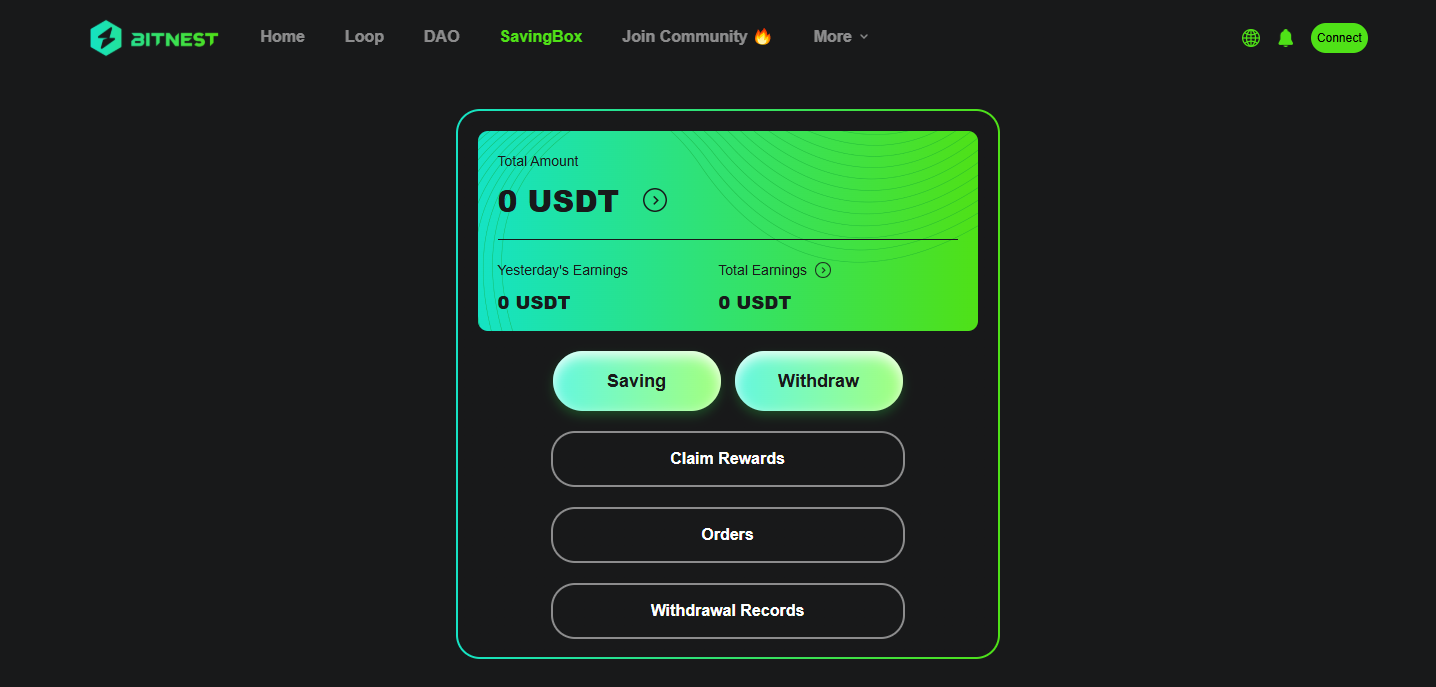
BitNest presents itself as a decentralized crypto-financial ecosystem where users can deposit digital assets and generate passive income through smart-contract-based products.

The platform promotes fixed returns, including a daily rate of 0.4% through Saving Box and returns of up to 24% over 28 days through BitLoop. At the same time, BitNest provides limited information about its legal entity, registration, licensing, and the source of the promised returns.

This combination makes BitNest a high-risk crypto investment platform rather than a conventional regulated cryptocurrency exchange.

What Is BitNest?

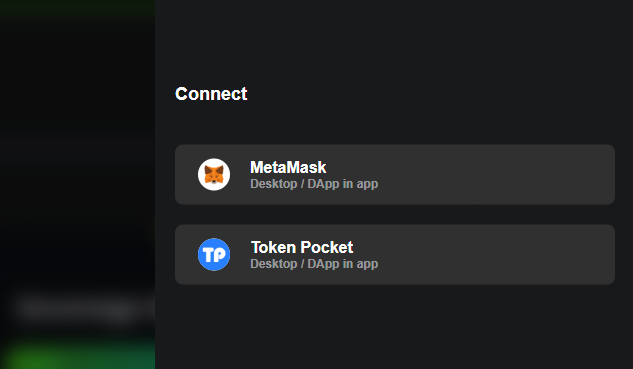
BitNest describes itself as a decentralized platform for managing digital assets and accessing different income-generating products. Instead of opening a traditional brokerage account, users connect a cryptocurrency wallet such as MetaMask and interact with the platform through blockchain transactions.

According to the available information, BitNest was launched in 2023. However, the platform does not provide clear corporate information confirming the legal entity behind the service, its jurisdiction, or financial licenses. A physical business address is also not disclosed.

The lack of corporate transparency is important because users placing funds into an investment product need to know who operates the platform and what legal protections are available if something goes wrong.

How Does BitNest Work?

BitNest uses a non-custodial wallet-based model.

The general process is straightforward:

  1. The user opens the BitNest website.
  2. A cryptocurrency wallet, such as MetaMask, is connected.
  3. The user selects an available product.
  4. The amount of USDT to be deposited is specified.
  5. The transaction is confirmed directly in the wallet.
  6. According to BitNest, subsequent calculations and returns are determined by smart-contract logic.

This model means BitNest does not function like a traditional centralized exchange where users maintain a conventional account balance.

However, decentralization does not automatically make a platform safe. The actual risks depend on the smart contracts, their permissions, liquidity, economic model, and the people or entities controlling the surrounding infrastructure.

Users also remain responsible for their wallets. Losing a seed phrase or access to a wallet cannot normally be resolved by BitNest support.

BitNest Investment Products

BitNest offers several products designed to generate returns from deposited crypto assets.

The two most prominent are Saving Box and BitLoop.

Saving Box

Saving Box is presented as a DeFi product connected to PancakeSwap.

Users deposit USDT and are promised a fixed daily return of 0.4%. The platform states that deposits can be made without a minimum amount and that funds can be deposited or withdrawn at any time. A fixed withdrawal fee of 0.1 USDT is also mentioned, excluding blockchain network fees.

The 0.4% daily rate deserves particular attention.

In conventional DeFi protocols, yields normally fluctuate according to liquidity, trading activity, borrowing demand, fees, and other market conditions. A fixed daily return therefore requires a clear explanation of where the money comes from and how the platform can maintain the promised rate.

Without sufficient information about the underlying revenue mechanism, the stated return cannot be treated as a conventional low-risk yield.

BitLoop

BitLoop is structured around predefined investment periods ranging from one to 28 days.

The stated returns are:

  • 1 day – 100.4% repayment
  • 7 days – 104%
  • 14 days – 109.5%
  • 28 days – 124%

For example, a 1,000 USDT placement for 28 days would theoretically result in a 1,240 USDT return under the stated conditions.

The main issue is not simply the size of the return. It is the lack of sufficient publicly available information explaining the economic mechanism behind it.

An investment product promising a predetermined return needs a sustainable source of revenue capable of financing those payments. BitNest’s public materials do not provide enough detail to independently verify this mechanism.

Bitnest Savings and Bitnest DAO

BitNest also promotes Bitnest Savings and Bitnest DAO.

Bitnest Savings is described as a tool for holding crypto assets, but the publicly available information provides limited detail about its exact terms, limits, and calculation mechanism.

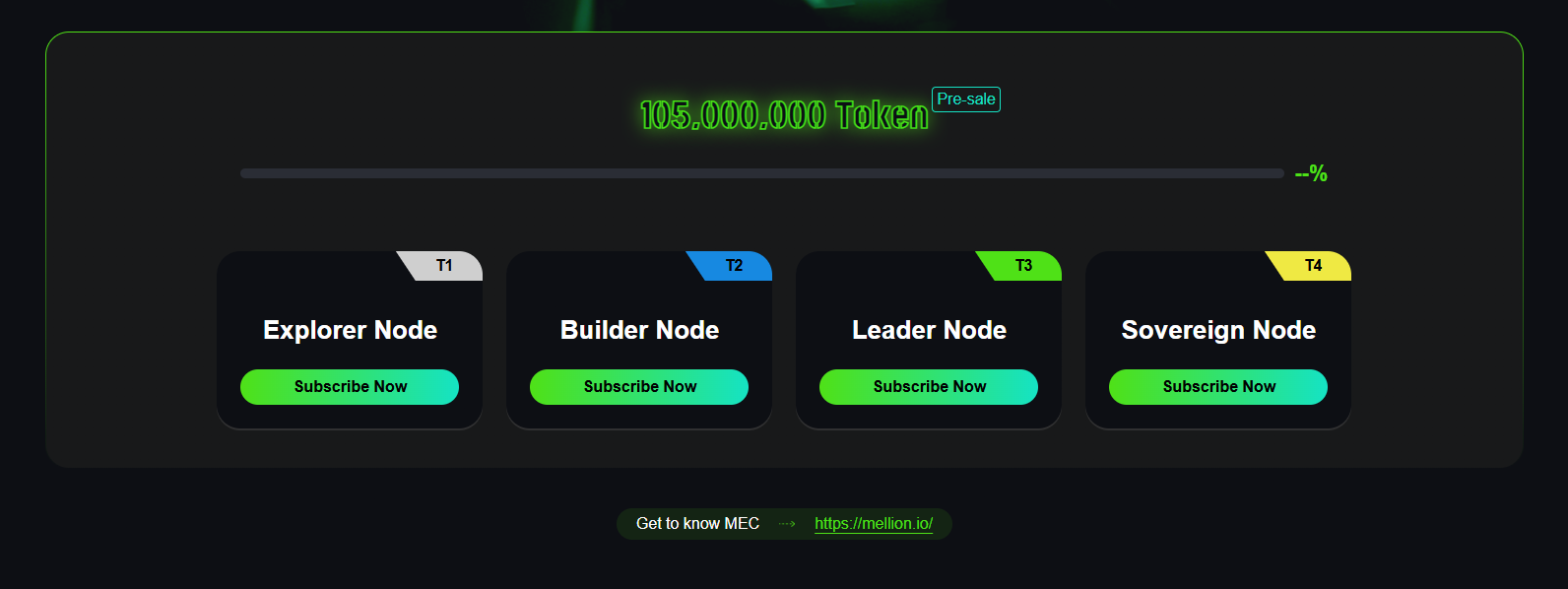
Bitnest DAO is associated with the project’s internal economy and the distribution of MellionCoin. However, the available materials do not provide sufficient financial or legal information to fully assess this structure.

This creates another area of uncertainty because the value of an internal token depends on its actual utility, liquidity, supply mechanics, and external demand.

MellionCoin

MellionCoin is BitNest’s internal cryptocurrency token.

Having a native token is not inherently suspicious. Many legitimate blockchain projects have their own tokens.

The relevant question is what role the token plays in the ecosystem and whether it has meaningful independent liquidity.

If bonuses or other forms of compensation are paid in an internal token rather than a widely traded asset such as USDT, users face an additional market risk. A nominal balance in an internal token does not necessarily represent an equivalent amount of withdrawable cash.

BitNest Referral Program

BitNest also operates a multi-level referral system.

The program reportedly contains up to 17 levels. The first level offers a 20% reward based on the income generated by referred participants. Lower levels receive smaller percentages, including 10%, 5%, 3%, and 1% depending on the level.

A referral program alone does not prove that a project is a pyramid scheme. However, a 17-level structure becomes relevant when combined with fixed investment returns.

The more strongly participant rewards depend on bringing new users into the system, the more important it becomes to determine whether returns are generated by an actual underlying business activity or primarily supported by continued participant inflows.

Deposits and Withdrawals

BitNest uses cryptocurrency wallets rather than conventional bank transfers.

To deposit funds, users connect their wallet, select a product, enter the amount of USDT, and approve the blockchain transaction. The available information states that deposits can start from 1 USDT.

Withdrawals are also performed through the connected wallet.

For Saving Box, BitNest states that a 0.1 USDT withdrawal fee applies in addition to the blockchain network fee.

The publicly available product descriptions do not fully explain every withdrawal scenario, particularly the conditions surrounding early withdrawals from certain products.

This is an important consideration because access to deposited funds is just as important as the advertised return.

Is BitNest Regulated?

There is no sufficient evidence in the available materials confirming that BitNest operates under a recognized financial regulator.

The platform does not clearly disclose its legal entity, jurisdiction, registration details, or financial licenses.

For a decentralized protocol, the absence of a traditional financial license does not automatically establish illegal activity. However, the issue becomes more significant when the platform accepts crypto deposits, promotes fixed returns, and operates a multi-level referral structure.

Users should therefore distinguish between two separate concepts:

Blockchain transparency means that certain transactions or smart-contract interactions may be visible on-chain.

Corporate transparency means knowing who operates the platform, where it is registered, and what legal obligations apply to it.

BitNest provides the former infrastructure but limited evidence of the latter.

BitNest Security

BitNest relies heavily on smart contracts and wallet interactions.

This creates several separate risk categories.

Smart-contract risk. Bugs or vulnerabilities can result in the loss of assets. An audit, where available, does not guarantee that a contract is completely secure.

Wallet risk. Users are responsible for their private keys and transaction approvals.

Phishing risk. Fake BitNest domains or malicious interfaces can be used to trick users into signing unauthorized transactions.

Liquidity risk. A platform may display balances or promised returns without guaranteeing that sufficient liquid assets are available for all withdrawals.

The available materials specifically note that an audit should not be interpreted as proof that all smart-contract vulnerabilities have been eliminated.

BitNest Reviews and User Complaints

Available reviews contain complaints concerning withdrawals, account restrictions, delayed payments, and additional payment requests.

These reports should not be treated as conclusive proof of fraud by themselves. User reviews can be inaccurate, incomplete, or impossible to independently verify.

Nevertheless, withdrawal complaints are particularly relevant for an investment platform. If users are asked to deposit additional funds before they can access previously deposited money or supposedly earned returns, this should be treated as a major warning sign.

Main BitNest Red Flags

Several risk factors appear simultaneously.

Limited corporate transparency. BitNest does not provide sufficient information about its legal operator, registration, or licensing.

High fixed returns. Saving Box advertises 0.4% per day, while BitLoop advertises up to 24% over 28 days.

Multi-level referrals. The referral structure reportedly extends to 17 levels, with 20% available at the first level.

Unclear source of yield. Public materials do not provide enough information to independently verify how the promised returns are generated.

Internal token exposure. MellionCoin introduces an additional layer of liquidity and valuation risk.

Smart-contract exposure. Using DeFi infrastructure introduces technical risks that cannot be eliminated simply by describing the platform as decentralized.

Withdrawal complaints. Available user reports include allegations of blocked withdrawals and requests for additional payments.

Final Verdict on BitNest

BitNest should not be viewed as a conventional regulated crypto exchange.

Its core offering is built around investment products promising predetermined returns rather than standard spot cryptocurrency trading. The platform combines fixed yields, smart-contract-based deposits, an internal token, and a multi-level referral program.

The biggest concern is the combination of these features with limited corporate transparency. BitNest does not provide enough publicly verifiable information about its legal operator, licensing, or the economic source of its promised returns.

This does not by itself establish that BitNest is fraudulent. It does, however, mean that the platform carries a substantially higher level of counterparty, technical, liquidity, and model risk than a transparent, established, regulated financial service.

For investors, the key issue is therefore not whether BitNest calls itself decentralized. The relevant question is whether the platform can transparently demonstrate how it generates the returns it promises and under what legal and technical framework users can recover their assets.

Based on the available information, BitNest should be treated as a high-risk crypto investment platform. Anyone considering using it should be prepared for the possibility of losing the deposited funds and should not treat the advertised returns as guaranteed income.

Zefeeco Broker Review 

Zefeeco presents itself as a brokerage platform offering access to several financial markets, including forex, stocks, indices, cryptocurrencies, metals, and commodities. The company uses several domains and provides clients with a web-based trading terminal as well as the CapitalRoute software.

At the same time, key information about the company remains unavailable. Zefeeco does not clearly disclose the legal entity operating the platform, its jurisdiction, registered address, or management. There is also no publicly confirmed information about a financial regulator or brokerage license.

The available trading information is limited as well. Zefeeco does not clearly publish its minimum deposit, spreads, commissions, swaps, or several other important account conditions.

This review examines what is known about Zefeeco, how its platform operates, and which factors should be considered before depositing funds.

Zefeeco Broker Overview

Zefeeco operates through the main domain zefeeco. com. Two additional domains associated with the platform are zefe-eco.world and ze-fco.link.

The company does not publicly identify the legal entity behind the Zefeeco brand. Its jurisdiction, registered address, and management details are also not disclosed. The publicly available contact information includes the email address support@zefeeco. com, while no company telephone number is provided.

The project is generally associated with 2026. At the same time, the main zefeeco. com domain was registered in 2022. This does not necessarily mean that the brokerage has been operating since 2022, as domain registration and the actual launch of a financial company are separate matters.

The two other domains appeared much later, in May and June 2026. Therefore, the age of the main domain should not be treated as evidence of a long-established brokerage history.

The main concern is the lack of transparency. A potential client cannot easily determine which legal entity provides the services, where it is registered, or which jurisdiction governs the relationship with the broker.

Zefeeco Registration and Regulation

Zefeeco does not disclose the jurisdiction in which the company is registered or provide sufficient corporate registration details. There is also no confirmed information about a brokerage license issued by a recognized financial regulator.

This is important because regulated brokers normally provide information about their legal entity, registration number, registered address, regulator, and license status.

Without these details, it is difficult for a potential client to independently verify the company’s regulatory status.

The lack of a disclosed jurisdiction also creates practical difficulties. A client cannot clearly determine which legislation applies, which regulator is responsible for supervision, or where a complaint should be submitted in case of a dispute.

If Zefeeco claims to operate under a specific license, the license should be verified directly through the official register of the relevant regulator rather than relying solely on information provided by the platform.

For clients in Russia, there is also no confirmed information indicating that Zefeeco is authorized by the Bank of Russia to provide brokerage services. However, because the company’s jurisdiction is not disclosed, this does not establish whether it may hold authorization elsewhere.

Zefeeco Websites and Platform Access

Zefeeco is associated with three domains: zefeeco. com, zefe-eco.world, and ze-fco.link.

Using multiple domains is not inherently problematic and is common among online financial platforms. However, in this case, the relationship between the domains is not explained in detail, while two of them were registered only in 2026.

Access to some of the resources may also be restricted. This can make it difficult for potential clients to review the company’s documentation, trading conditions, and other important information independently.

Users should also make sure they are accessing the correct official platform before entering login credentials or making financial transactions.

Account Registration

Opening an account with Zefeeco requires standard registration information, including the user’s first and last name, country of residence, contact details, and password.

Additional identification may be required before certain features become available, including financial operations. The platform may request passport information as part of its verification process.

KYC verification is a standard procedure in the financial industry and is not, by itself, a reason for concern.

However, clients should know which legal entity receives their personal information and under what legal framework that information is processed.

Because Zefeeco does not clearly identify its operating company, this aspect remains difficult to verify.

Trading Instruments

Zefeeco claims to provide access to several asset classes. These include forex, stocks, stock indices, cryptocurrencies, metals, and commodities.

The platform is therefore presented as a multi-asset brokerage service where different markets can be accessed through a single account.

However, a general list of asset classes does not provide enough information to assess the actual trading conditions.

The available information does not provide a complete list of instruments, contract specifications, trading hours, or other important parameters.

There is also insufficient information about the actual cost of trading. Spreads, commissions, and swap charges are not clearly disclosed in a comprehensive public schedule.

Trading Accounts and Demo Account

Zefeeco offers a demo account that allows users to test the trading interface with virtual funds.

The information about real trading accounts is considerably more limited.

The broker does not clearly publish its minimum deposit, account types, or complete conditions for real-money trading.

Other important parameters, including maximum leverage, minimum trade size, spreads, commissions, and swaps, are also not clearly confirmed.

This makes it difficult for a potential client to estimate the actual cost of trading or compare Zefeeco with established brokers.

The availability of a demo account should also not be interpreted as evidence of the broker’s reliability. A demo environment can demonstrate the functionality of a trading interface, but it does not establish that the company is properly regulated or that real client orders are executed in external financial markets.

CapitalRoute Trading Platform

Zefeeco offers the CapitalRoute software as an additional trading solution. Clients can also access a browser-based trading terminal.

The interface provides standard trading features such as charts, price information, account balance, and open positions.

However, Zefeeco does not clearly identify the developer of CapitalRoute, its liquidity providers, or the sources of the market prices displayed on the platform.

The available information also does not make it possible to establish how client orders are executed or whether they are actually routed to external markets.

This distinction is important. The existence of a trading terminal does not by itself prove that transactions are executed in the underlying market.

A proper assessment would require documentation covering order execution, counterparties, liquidity providers, and the company’s execution policy.

Staking and Referral Program

In addition to trading, Zefeeco reportedly offers a staking feature through its client account.

However, the available information does not clearly explain which protocol is used, who holds the assets, how the staking mechanism works, or under what conditions users can withdraw their cryptocurrency.

Clients should understand these details before transferring cryptocurrency into any staking program.

Zefeeco also offers a referral program. Users can reportedly receive rewards for introducing new clients when certain conditions related to the referred client’s deposit are met.

Referral programs are not unusual among online platforms. However, they should not be viewed as evidence of regulation, financial stability, or trading reliability.

Deposits

Financial operations are managed through the Zefeeco client area.

The available information indicates that cryptocurrency can be used to fund the account. Account balances may be displayed in USD, RUB, and certain other currencies.

However, Zefeeco does not provide a comprehensive public list of payment methods, deposit limits, processing times, or applicable fees.

It is also unclear whether bank card deposits are supported.

Before transferring funds, clients should verify the exact payment details and determine which legal entity or payment provider receives the money.

Withdrawals

Withdrawal conditions are one of the least transparent aspects of the Zefeeco platform.

The company reportedly supports cryptocurrency transactions, but detailed information about withdrawal limits, fees, and processing times is not clearly published.

Particular attention should be paid to any request for additional payments before a withdrawal is processed.

One published user review alleges that the client was asked to purchase insurance before being allowed to withdraw funds.

This claim cannot be independently verified based on the available information and should not be treated as conclusive evidence of misconduct by Zefeeco.

Nevertheless, if a client is asked to make an additional payment for insurance, taxes, account unlocking, AML verification, or another service before receiving an existing account balance, the request should be carefully investigated.

Any mandatory fee should have a clear contractual basis and be disclosed in the broker’s terms. Repeated demands for additional deposits immediately before a withdrawal are a significant warning sign.

What Should Be Checked Before Depositing Funds?

Before opening a real-money account with Zefeeco, a potential client should request and verify the company’s legal and trading documentation.

The first step is to establish the full legal name of the company, its country of registration, registration number, and registered address.

Any claimed financial license should then be verified through the official register of the relevant regulator.

Clients should also review the complete client agreement, privacy policy, deposit and withdrawal rules, and fee schedule.

It is also worth requesting information about order execution, liquidity providers, and the legal relationship between CapitalRoute and the company operating the Zefeeco platform.

If the company does not provide these documents or asks the client to deposit funds before the relevant information is available, opening a real-money account should be approached with caution.

Final Verdict on Zefeeco

Zefeeco offers a broad range of advertised financial instruments, including forex, stocks, indices, cryptocurrencies, metals, and commodities. The platform provides a demo account and access to both a web-based terminal and CapitalRoute.

However, the available information about the company itself is considerably less comprehensive.

Zefeeco does not clearly disclose its operating legal entity, jurisdiction, registered address, or management. Its regulatory status and brokerage license have not been independently confirmed. Important trading conditions, including the minimum deposit, spreads, commissions, swaps, and leverage, are also not sufficiently disclosed.

There are additional questions concerning the trading infrastructure. The company does not clearly identify the developer of CapitalRoute, its liquidity providers, the sources of its price data, or the mechanism used to execute client orders.

Withdrawal conditions also require attention, particularly in light of user reports alleging additional payment requirements before funds could be withdrawn. These reports cannot independently establish fraudulent activity, but they represent a relevant risk factor when combined with the platform’s broader lack of transparency.

Based on the information currently available, Zefeeco does not provide enough verifiable information to be considered a transparent brokerage service.

Until the company provides verifiable corporate details, regulatory information, clear client terms, comprehensive trading conditions, and transparent withdrawal procedures, opening a real-money account with Zefeeco carries a significant level of uncertainty and risk.

Oneitwoh Broker Review

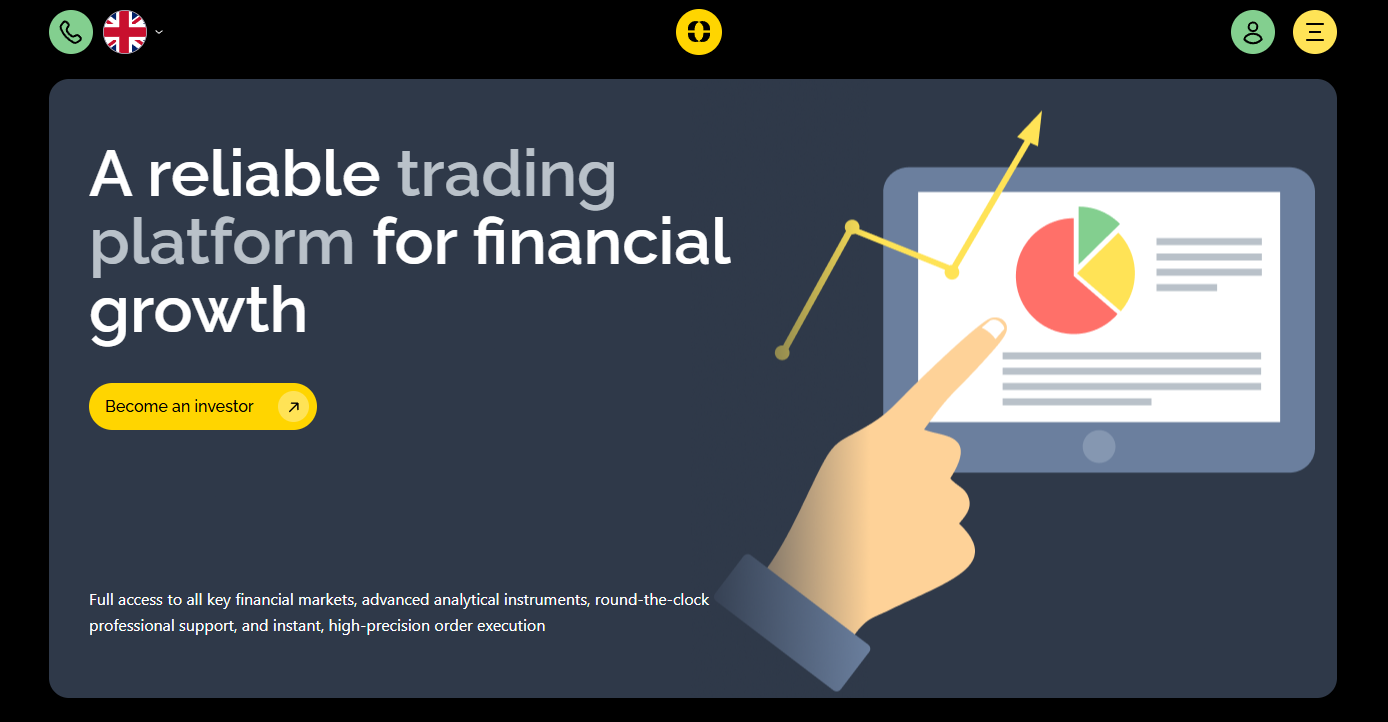
Oneitwoh presents itself as an international trading platform offering access to some of the most liquid financial assets. The company claims to have extensive experience in the financial industry, use a proprietary trading terminal, cooperate with major liquidity providers, and have received professional industry awards.

However, these claims are primarily presented in textual form and are not supported by licenses, certificates, or other independent documentation. Questions also arise regarding the broker’s regulatory status, corporate information, domain history, trading conditions, and withdrawal procedures.

This Oneitwoh review examines the available information about the company, its claimed regulation, contact details, websites, domain data, trading accounts, legal documents, withdrawal procedures, and user complaints.

Oneitwoh Registration and Regulation

Oneitwoh claims to have eight years of experience in the financial markets, stating that its operations began in 2018. The broker also claims to operate under the supervision of several international regulators, including CSSF, FCA, VFSC, and DFSA.

However, the broker’s website does not provide copies of its licenses, registration certificates, or other official documents confirming these claims. Therefore, the stated regulatory status requires independent verification through the official registers of the relevant authorities.

According to the information provided for this review, searches of the registers of the regulators mentioned by Oneitwoh did not identify the broker. As a result, the company’s claims of international regulatory oversight remain unsupported.

The company was also checked against the database of the Central Bank of Russia. According to the provided materials, Oneitwoh was included in the regulator’s warning list on April 29, 2026. The company was identified as displaying signs of an illegal professional participant in the securities market.

Being included in such a warning list represents a significant risk factor for potential clients. Combined with the lack of verifiable licensing information, it raises serious concerns about the broker’s legal status.

Oneitwoh Contact Details

Oneitwoh provides several methods of contacting its support team. Clients are supposedly able to send written inquiries to [email protected] or use a contact form on the website. The company also lists the following telephone number:

+54 9 11 4728-5931.

The company claims to be headquartered in Argentina at:

Santo Tome 3096, C1417GFO, Autonomous City of Buenos Aires, Argentina.

The contact information raises several additional questions.

According to the provided materials, the email address [email protected] did not pass an email registration check. Users have also reported difficulties communicating directly with the company’s representatives.

The telephone number is also questionable. According to user reports, calls reportedly result in a fax response, making direct communication with the company difficult.

The stated Buenos Aires address also requires caution. The location itself exists, but the available information does not confirm that Oneitwoh actually operates from this address. The provided materials indicate that the company has not been registered there since 2018, despite claiming to have operated since that year.

As a result, the broker’s principal communication channels do not provide sufficient evidence of a transparent and verifiable financial organization operating from the stated jurisdiction.

Oneitwoh Websites

The following domains are associated with Oneitwoh:

  • oneitwoh.me;
  • ont-woh.com;
  • oneit-woh.link.

The use of several different domains does not automatically indicate illegal activity. However, in the context of the other issues identified during the review, the existence of multiple domains adds another point that requires attention.

The primary website appears to be oneitwoh.me, which is used to present the broker’s services and trading platform.

Oneitwoh Trading Conditions

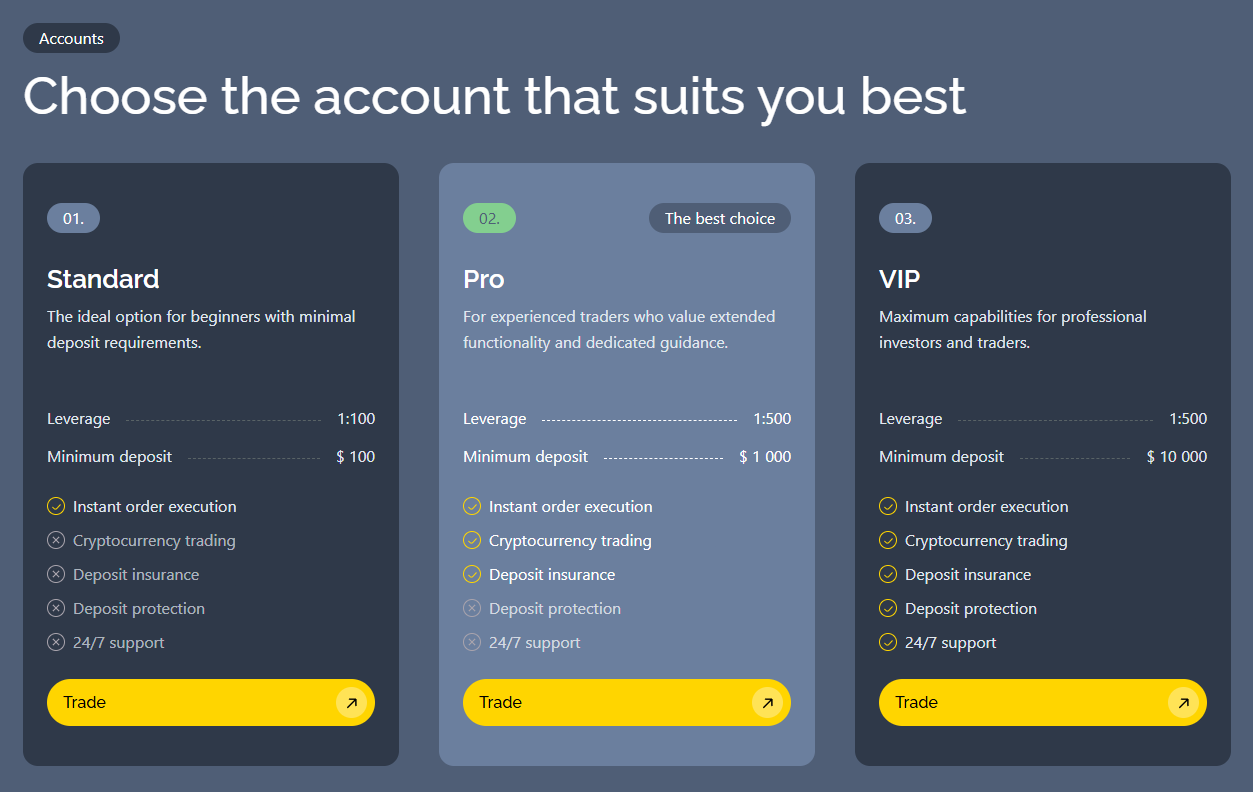
Oneitwoh offers three main trading account types.

The Standard account requires a minimum deposit of $100. The broker advertises leverage of up to 1:100 and claims that orders are processed instantly.

The Pro account requires a minimum deposit of $1,000. Leverage can reportedly reach 1:500, while cryptocurrency trading and capital insurance are also advertised.

The VIP account starts at $10,000. The advertised leverage is again up to 1:500. Additional features supposedly include fund security, a personal manager available 24/7, and the highest execution priority.

The advertised leverage is one of the points that deserves particular attention. Retail clients trading in the European regulatory environment are subject to significantly stricter leverage restrictions, including a maximum of 1:30 for major currency pairs.

Therefore, Oneitwoh’s advertised leverage of up to 1:500 does not correspond to the standard restrictions applicable to retail clients under European regulatory frameworks and requires further explanation from the company.

At the same time, the available materials do not provide sufficient information about spreads, commissions, specific trading instruments, execution methodology, or other important trading parameters.

Oneitwoh Documents and Policies

Oneitwoh publishes a standard collection of internal policies and legal documents. These include:

  • User Agreement;
  • Risk Disclosure Statement;
  • Anti-Money Laundering Policy;
  • Conflict of Interest Policy;
  • Withdrawal and Refund Policy.

The presence of legal documents on a website does not by itself prove that a broker is regulated or legitimate. Their contents, corporate details, and the identity of the legal entity responsible for the platform are much more important.

According to the provided materials, the Oneitwoh documents do not contain sufficient corporate information, registration numbers, or complete legal details that would allow clients to clearly identify the company behind the platform.

The documents also appear to place substantial limitations on the company’s liability in situations involving potential losses or account restrictions.

This is particularly significant when combined with the absence of independently confirmed licensing. If the legal entity behind a trading platform cannot be clearly identified, a client may face considerable difficulties determining which jurisdiction and legal framework apply in the event of a dispute.

Oneitwoh Withdrawals

Oneitwoh advertises several methods for depositing and withdrawing funds. These reportedly include cryptocurrency transactions, bank transfers, payment cards, and electronic wallets.

The broker states that withdrawal requests can take up to 72 hours to process. However, the available information does not clearly specify withdrawal limits or provide a complete breakdown of applicable fees.

More serious concerns arise from user reports regarding the actual payment process. Some traders claim that they were instructed to transfer funds to third-party bank cards or cryptocurrency wallet addresses.

Such practices require particular caution because clients should be able to clearly identify the legal entity receiving their funds and understand which party is responsible for those funds.

The most serious complaints concern withdrawal attempts. According to user reports, once a withdrawal request was submitted, representatives allegedly demanded additional payments before releasing the funds.

The reasons reportedly included taxes, insurance payments, commissions, tax-code verification, and other financial checks. Some users also describe demands involving a beneficiary or trusted person who supposedly needed to participate in the withdrawal process.

These reports are especially concerning because legitimate withdrawal procedures should be clearly documented in advance rather than repeatedly generating new payment requirements after a client requests access to their own funds.

Conclusion: Is Oneitwoh a Legitimate Broker?

The review of Oneitwoh reveals several significant warning signs.

The company claims to have operated since 2018 and to be regulated by CSSF, FCA, VFSC, and DFSA. However, the provided materials contain no independently verified evidence of these licenses, and searches of the relevant regulatory registers reportedly failed to identify the broker.

Another major concern is the reported inclusion of Oneitwoh on the Central Bank of Russia’s warning list dated April 29, 2026.

The company’s contact information also raises questions. The listed email address reportedly fails registration checks, the telephone number is allegedly difficult to reach, and the stated Buenos Aires address does not provide sufficient evidence of an actual company presence.

The primary oneitwoh.me domain was registered in 2021, despite the company’s claimed 2018 start date. ScamAdviser reportedly assigns the website a trust score of only 56/100, while IPQS has recorded complaints associated with phishing and fraudulent activity. The domain owner’s identity is also hidden through a privacy service.

The trading conditions create further concerns. Oneitwoh advertises leverage of up to 1:500 while failing to provide sufficient information about several important trading parameters. Its legal documents also do not appear to contain enough corporate information to clearly establish the identity and legal responsibility of the platform operator.

Finally, withdrawal-related complaints are particularly serious. Users report additional payment demands, difficulties accessing their funds, questionable payment arrangements, and concerns about the LogicPort trading terminal.

Taken together, these factors do not allow Oneitwoh to be considered a transparent or trustworthy financial intermediary. Potential clients should treat the platform as high risk and avoid transferring funds unless the company can provide verifiable evidence of its legal registration, regulatory authorization, corporate identity, and legitimate mechanisms for holding and withdrawing client funds.

Eceburc Broker Review 

Eceburc presents itself as an international broker offering clients access to financial markets and claiming to provide trading conditions designed to support stable capital growth.

However, information available online raises serious concerns about the company’s actual operations. Traders have reportedly experienced difficulties withdrawing funds from the AssetCenter trading terminal, while some of the information presented by the broker cannot be independently verified.

For this reason, it is important to examine Eceburc’s claimed registration, licensing, contact information, domains, trading conditions, legal documentation, withdrawal procedures, and available client feedback before considering any cooperation with the company.

Eceburc Registration and Licensing

According to information published on its official website, Eceburc has allegedly been operating since 2018, is registered in Argentina, and operates under licenses supposedly issued by CSSF, FCA, VFSC, and DFSA.

However, the broker does not provide sufficient documentation that would allow these claims to be independently verified. In particular, there are no accessible licenses, registration certificates, or other official documents confirming the company’s regulatory status.

The relevant official registers of the regulators named by Eceburc were therefore checked. Eceburc could not be found among the licensed companies listed by any of these regulators.

The company was also checked against the Russian financial regulator, the Bank of Russia. The broker could not be found in the relevant register there either.

As a result, Eceburc’s claims regarding its regulatory licenses could not be confirmed through official sources. This is a significant risk factor because an unverified regulatory status means that clients may not have access to the protections normally associated with regulated financial services.

Eceburc Contact Details

Eceburc provides several contact details for clients. The company lists the email address [email protected] and the telephone number +54 11 4550-2198.

The broker also claims to have a registered and physical office at:

Cabildo Avenue, 1100, Autonomous City of Buenos Aires, C1426, Argentina.

The email address raises an immediate concern. According to the email verification data provided in the research materials, [email protected] does not exist.

If the listed support address is indeed inactive, this may explain complaints from users who report receiving no response from company representatives by email.

The physical address also requires closer examination. A check of the stated location using online maps did not identify an Eceburc office. Unlike several neighboring businesses, the broker has no visible business listing or office marker at the stated location.

The company was also checked through info-clipper.com, a platform used to verify website registration information. Eceburc could not be found in the service’s database.

Taken together, these findings make it difficult to independently confirm that the stated address actually belongs to Eceburc. Given the lack of verified licensing and transparent registration information, this represents another significant risk factor.

Eceburc Websites

Eceburc operates several domains:

  • eceburc.com – the main presentation website;
  • ece-burc.biz – the trading terminal.

Using separate domains for a company’s corporate website and trading platform is not inherently unusual. However, the age of the trading domain deserves attention.

The ece-burc.biz domain was registered on May 7, 2026. This means that the trading infrastructure is associated with a relatively new domain, despite the company’s claim that it has been operating since 2018.

The difference between the claimed operating history and the age of the trading domain therefore warrants additional scrutiny when assessing the broker’s reliability.

Eceburc.com Domain Check Results

The main Eceburc domain also raises several questions.

According to ScamAdviser, the website has an active SSL certificate and has existed for several years. At the same time, the service notes low website traffic and warnings from Pulsedive and IPQS, which classify the domain as potentially suspicious.

According to WHOIS, the eceburc.com domain was registered on March 1, 2022, and is valid until March 1, 2027. The registration record was last updated on April 12, 2026.

GoDaddy is listed as the registrar. The website server is located in Moldova, while the company claims to be registered and operating in Argentina. The domain owner’s information is also hidden, making it impossible to determine from public records who actually controls the website.

Additional information is available through the Wayback Machine. The first available archived copies of eceburc.com date back to 2023. At that time, however, the domain was being used by a Turkish construction company and contained information about a residential development.

Therefore, the current Eceburc website is not the original content associated with the domain. A domain changing ownership does not, by itself, prove that a company is fraudulent. Nevertheless, when combined with the other inconsistencies identified during the investigation, this history deserves consideration.

Eceburc Trading Conditions

Eceburc offers three types of trading accounts. They differ in terms of the minimum deposit, leverage, and available conditions.

The Standard account requires a minimum deposit of $150 and offers leverage of up to 1:20.

The Pro account requires a minimum deposit of $5,000 and provides leverage of up to 1:50.

The VIP account requires a minimum deposit of $25,000, with leverage of up to 1:100.

The maximum leverage of 1:100 deserves particular attention. If the company were actually providing services to retail clients in European Union jurisdictions, such conditions would conflict with the applicable European restrictions. Since 2018, leverage for most major currency pairs offered to retail clients has been limited to 1:30.

This creates another inconsistency between Eceburc’s advertised trading conditions and the regulatory framework referenced by the company.

Eceburc Policies and Legal Documents

The broker publishes a standard set of internal documents, including:

  • Terms and Conditions;
  • Risk Disclosure;
  • Anti-Money Laundering (AML) Policy;
  • Conflict of Interest Policy;
  • Withdrawal and Refund Rules.

The structure of these documents largely resembles the standard documentation used by most online brokers.

However, several provisions deserve attention. The documentation significantly limits the company’s responsibility for potential financial losses suffered by clients.

In particular, risks associated with reductions in account balances, loss of funds, technical failures, market fluctuations, and other circumstances affecting a trading account are largely assigned to the client.

Such provisions can also appear in the legal documentation of legitimate brokers and should not, on their own, be interpreted as proof of fraudulent activity. However, when the broker’s licensing cannot be independently confirmed and other aspects of its corporate information raise questions, these liability limitations become another factor that prospective clients should consider.

Eceburc Withdrawals

Eceburc claims to support several methods for depositing and withdrawing funds, including bank cards, international SWIFT transfers, electronic payment services, and cryptocurrency wallets.

At the same time, complaints contained in the available research materials describe concerns about how payments are processed. Some users claim that account funding was made not to a company bank account but to the bank cards of third parties, commonly referred to as “drop” accounts.

There are also reports of cryptocurrency deposits being sent to newly created wallet addresses with no previous transaction history.

These circumstances warrant caution. Clients should be able to understand exactly who receives their money and which legal entity is the actual beneficiary of a payment. If funds are transferred to payment details that cannot be directly connected to the broker, identifying the recipient and pursuing a potential dispute can become significantly more difficult.

Final Verdict on Eceburc

The investigation into Eceburc identified several discrepancies between the company’s claims and information that could be independently verified.

The alleged CSSF, FCA, VFSC, and DFSA licenses could not be confirmed through the relevant official registers. The company’s claimed registration in Argentina also lacks sufficient independent confirmation. The stated physical address could not be verified as an Eceburc office through online maps, while the listed support email reportedly does not exist.

The history of the eceburc.com domain raises further questions. The domain was registered in 2022, its ownership information is hidden, and archived versions show that it was being used by an unrelated Turkish construction company in 2023.

The trading domain ece-burc.biz was registered only on May 7, 2026, despite Eceburc’s claim of operating since 2018. In addition, users have reported difficulties withdrawing funds and being asked to make additional payments after submitting withdrawal requests.

Taken together, these factors indicate a substantial level of risk. Based on the available information, Eceburc does not provide enough independently verified evidence of being a transparent and properly regulated broker. For this reason, depositing funds with the company appears to involve a high level of risk and should be approached with extreme caution.

Finnova Limited Review 

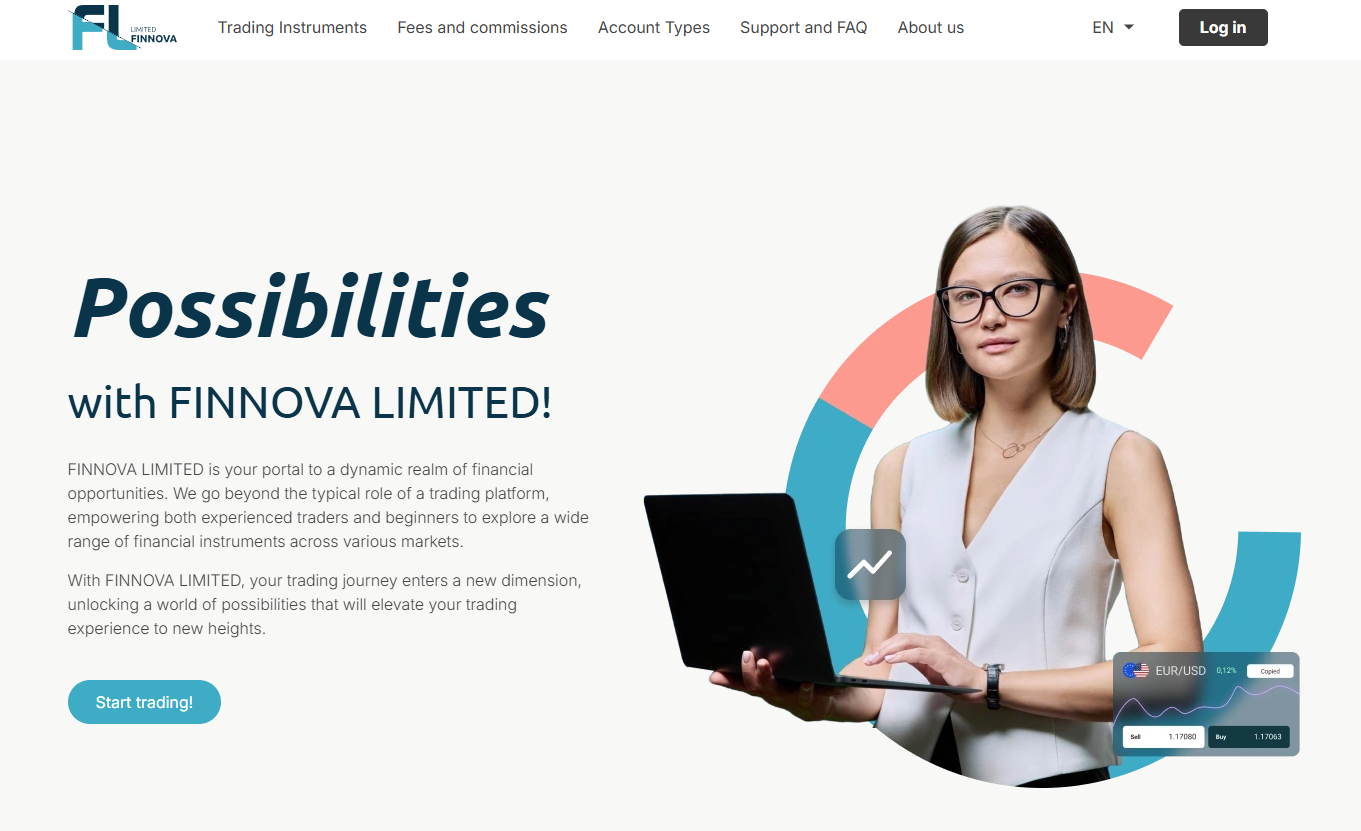
Finnova Limited presents itself as an online investment and trading platform offering access to financial markets to both beginner investors and experienced traders. The company claims to provide convenient access to global markets and offers several account types with different deposit requirements and trading conditions.

However, a review of the available information raises a number of questions regarding the company’s licensing, corporate transparency, domain history, trading conditions, and withdrawal procedures. Client feedback also contains repeated complaints concerning blocked accounts and difficulties withdrawing funds.

Finnova Limited Registration and License

According to the information published on its website, Finnova Limited started operating in 2019. The company claims that it was established to create a convenient platform providing access to global financial markets for both beginners and experienced traders.

At the same time, the website does not provide evidence of a financial license from the relevant jurisdiction, including authorization from the UK FCA. A search under the broker’s name did not identify Finnova Limited among the licensed entities.

An additional check against the official website of the Central Bank of Russia also did not identify a license issued to Finnova Limited.

Therefore, the available checks do not confirm that Finnova Limited holds the regulatory permissions necessary to provide brokerage services in the jurisdictions examined. The company’s stated operating history alone is not sufficient to establish that it is a regulated financial intermediary.

Finnova Limited Contact Details

Finnova Limited lists the following contact information:

Email: [email protected]

Phone: +44 1975 968284

Head office address:

77 Totteridge Drive, High Wycombe, Buckinghamshire, United Kingdom, HP13 6UQ.

The provided email address was found to be active.

The stated office address also exists. However, its appearance does not provide convincing evidence of a fully established brokerage office. The location is not clearly identified on maps as an office belonging to Finnova Limited.

For a company claiming several years of activity in the financial sector, the lack of additional evidence confirming its physical presence is an issue worth considering when assessing its overall transparency.

Finnova Limited Websites

Finnova Limited uses several domains for different parts of its service:

  • finnova-limited.com – the company’s main website;
  • user.finnova-limited.org – user account area;
  • wt.finnova-limited.net – web trading terminal;
  • user.finnova-limited.net – trader account area.

Using several domains and domain extensions is not inherently a violation. Companies may separate their corporate website, client area, and trading terminal across different domains.

The main point of concern here is the history of the primary domain, finnova-limited.com, which does not fully correspond with the company’s stated history.

Finnova-limited.com Domain Check Results

A check through Scamadviser does not provide additional confidence in the project. According to the service, the website has a below-average trust rating, while the available user feedback is predominantly negative.

The WhoIs data indicates that the finnova-limited.com domain was registered on July 31, 2025. The information provided also indicates an update on September 30, 2025. The server is located in the United States, in San Jose, California, while the domain owner information is hidden.

This creates a noticeable discrepancy. Finnova Limited claims that its business started in 2019, while its main domain was only registered in 2025. A recently registered domain does not, by itself, prove fraudulent activity, but it is an important factor when assessing a company that claims a significantly longer operating history.

A check through the Wayback Machine also provides historical information about the domain and its use as a web resource associated with the broker.

Finnova Limited Trading Conditions

Finnova Limited offers four trading account types. They differ primarily in terms of the minimum deposit and the additional services or conditions advertised to clients.

The minimum deposits are as follows:

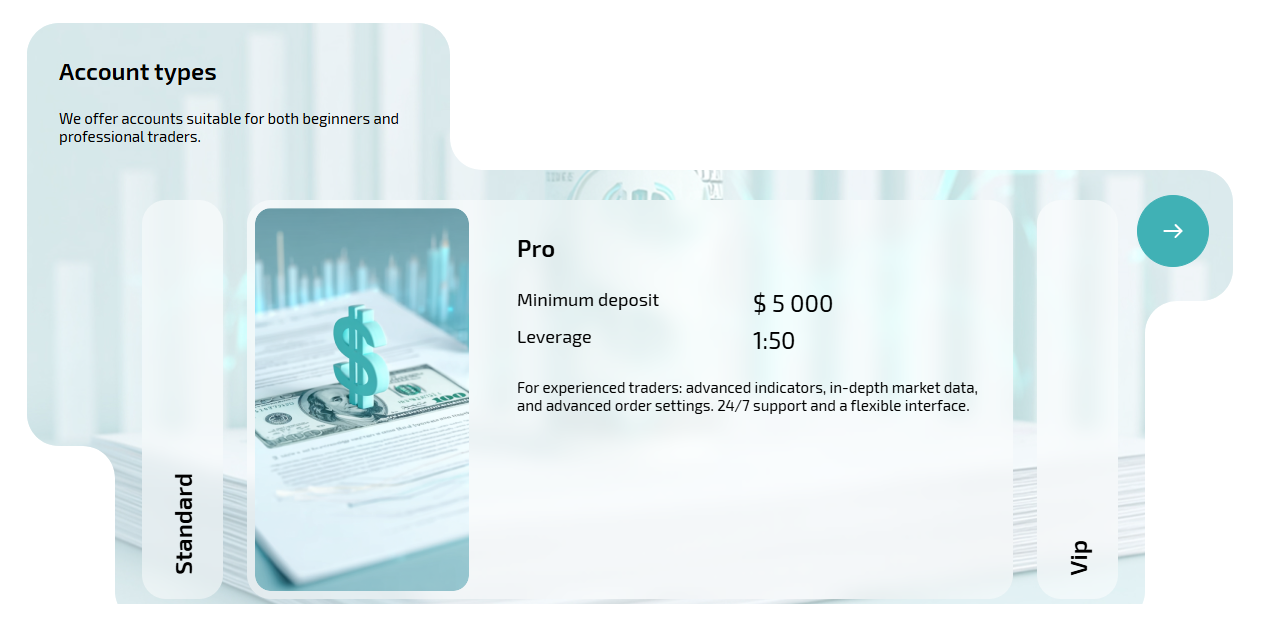
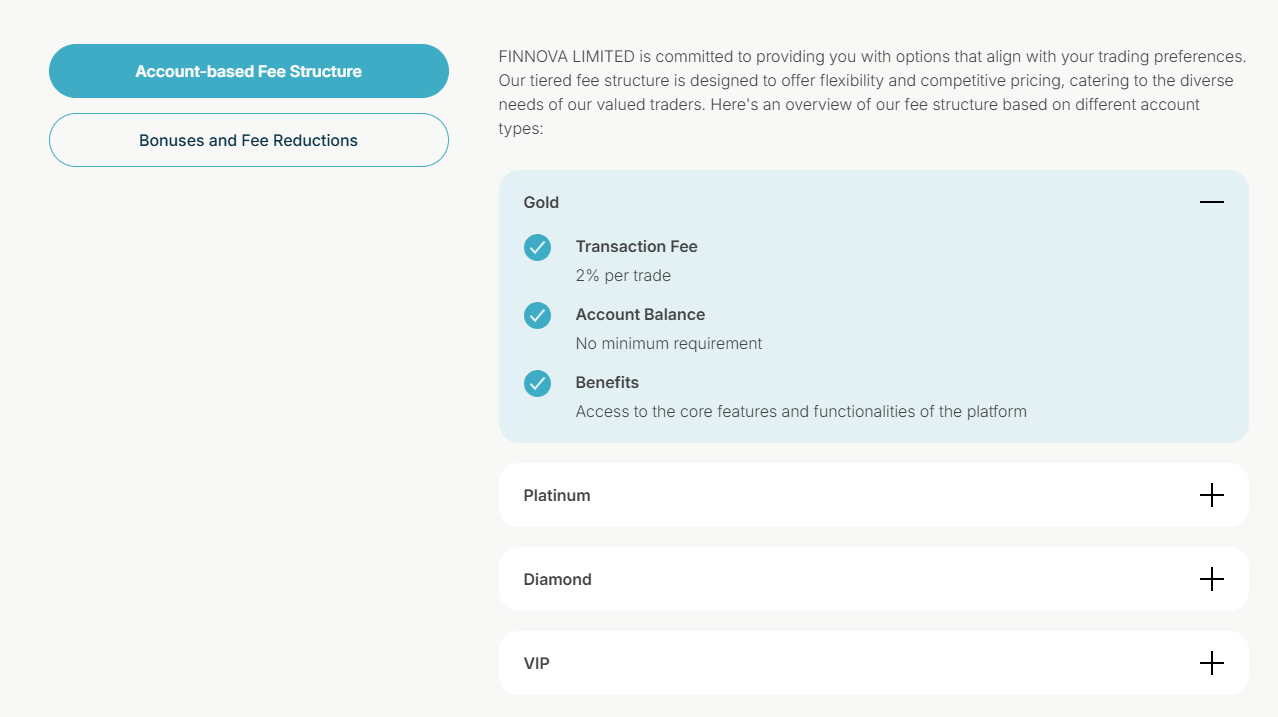
  • GOLD – from $250;
  • PLATINUM – from $5,000;
  • DIAMOND – from $10,000;
  • VIP – from $40,000.

All account types are presented as using the same TRADE platform, with leverage of up to 1:1000.

There is also inconsistent information concerning commissions. Some account descriptions indicate commissions of 5% and 10%, while the general trading conditions mention a fixed 2% commission.

Such discrepancies make it difficult for a potential client to determine the actual cost of trading before opening an account.

Another significant issue is the advertised leverage of 1:1000. Such leverage substantially increases the potential risk of trading because even relatively small market movements against an open position can result in significant losses.

This is particularly relevant given that the platform offers accounts requiring deposits of several thousand or even tens of thousands of dollars. Clients considering such accounts should have a clear understanding of the risks, costs, and regulatory status of the provider before committing substantial funds.

Finnova Limited Policies and Other Documents

Finnova Limited makes several internal documents available to users. These documents are intended to establish the rules governing the relationship between the company and its clients.

The available documents include:

  • Client Agreement;
  • Conflict of Interest Policy;
  • Privacy Policy.

However, the documents do not provide significant additional information that would substantially improve the transparency of the company’s operations.

The policies also contain provisions limiting the broker’s responsibility for certain circumstances involving clients’ financial losses and force majeure events.

The presence of legal documents on a website does not, therefore, automatically establish the reliability of a financial company. More important is whether the company’s obligations toward clients, including its responsibilities concerning funds and trading operations, are clearly defined and supported by appropriate regulation.

Finnova Limited Withdrawals

Finnova Limited allows clients to fund their trading accounts using cryptocurrency and cryptocurrency transfers.

The company lists several withdrawal methods, including:

  • bank transfers;
  • payment cards;
  • electronic payment systems;
  • cryptocurrency wallets.

At the same time, the website does not provide sufficiently detailed information regarding withdrawal processing times, applicable limits, or the fees that may be charged.

As a result, potential clients cannot clearly determine in advance how long a withdrawal may take or what costs and restrictions may apply.

The lack of transparent withdrawal conditions is particularly important for a financial platform because access to deposited funds is one of the key factors in evaluating the reliability of a broker.

Final Verdict on Finnova Limited

The review of Finnova Limited reveals several factors that should be considered before establishing a relationship with the company.

Finnova Limited claims to have been operating since 2019, while the main finnova-limited.com domain was registered only in July 2025. The regulatory checks described above do not confirm the company’s licensing with the FCA or the Central Bank of Russia. Information about trading commissions is also inconsistent, while withdrawal conditions are not disclosed in sufficient detail.

Additional concerns include the lack of clear evidence confirming the company’s physical office, the use of multiple domains, and predominantly negative client feedback. The complaints repeatedly focus on withdrawal difficulties, blocked accounts, and additional financial requirements appearing when clients attempt to access their funds.

None of these factors alone can conclusively establish that Finnova Limited is a scam. However, taken together, they significantly reduce the level of confidence that can reasonably be placed in the platform.

Based on the available information, Finnova Limited cannot be regarded as a transparent and reliably regulated broker. Potential clients should therefore exercise extreme caution and independently verify the company’s regulatory status, operating history, trading conditions, and withdrawal procedures before considering any financial commitment.

Kebridom Broker Review

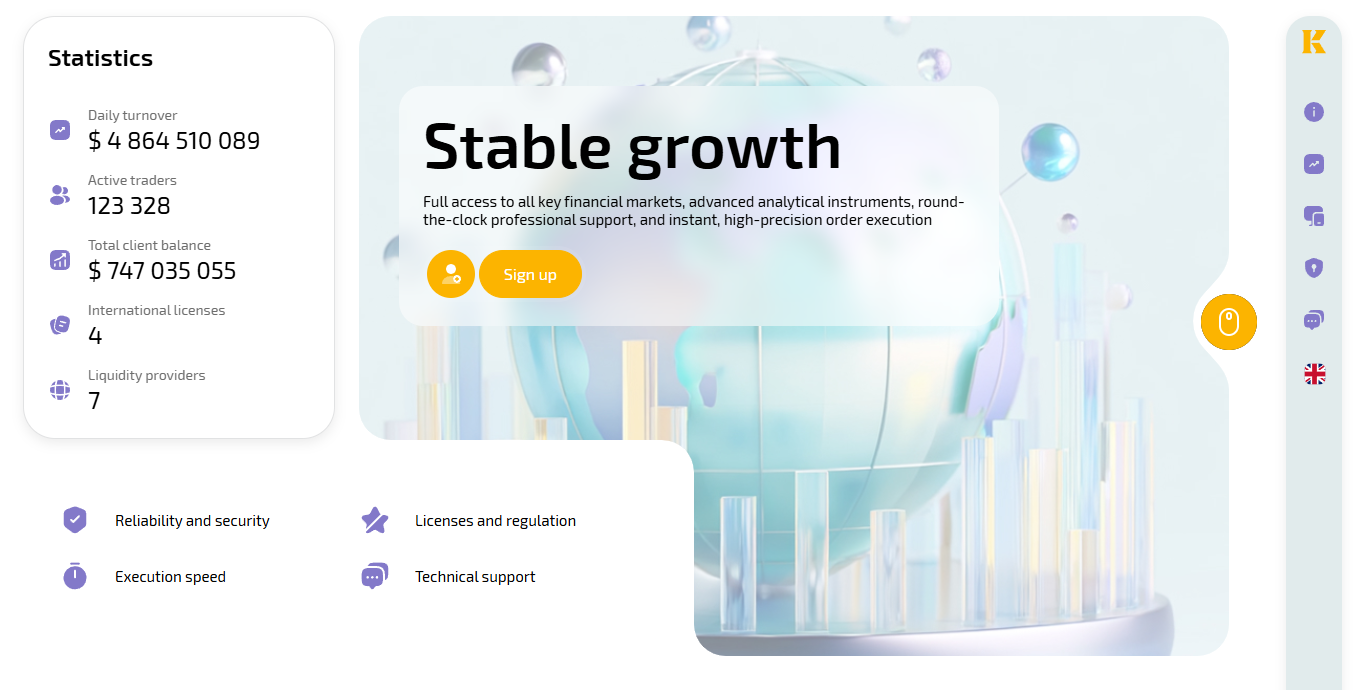
Kebridom presents itself as a global forex broker that has created everything necessary for trading and increasing traders’ capital. The main website serves as a presentation page where visitors can review the available markets, trading conditions, and offers for beginners without registering.
The website itself creates the impression of a fully established financial intermediary. However, information from open sources and user reviews raises questions about the company’s claims. According to clients, many people discovered Kebridom through advertising or after being contacted by managers, registered with the platform, and deposited funds. After opening an account, some users encountered problems and accused the company of acting unfairly.

Registration and License of Kebridom

According to the information published on its website, Kebridom has been operating on the international market since 2018 and has received numerous awards during this period. The company also lists several financial regulators as evidence of its reliability: VFSC, DFSA, CSSF, and FCA.

However, the website does not provide any documents confirming these licenses. Kebridom does not publish a certificate of registration, the company’s full legal name, or copies of licenses with numbers that could be used to verify the information.

A search for Kebridom in the official registers of VFSC, DFSA, CSSF, and FCA produced no results. Therefore, the list of regulators presented by the company cannot be considered confirmation that Kebridom actually holds the claimed licenses.

The company was also checked against the register of the Central Bank of Russia. Kebridom was not found there either. Consequently, there is no confirmed authorization for the company to provide brokerage services to Russian clients.

Kebridom Contact Details

The company provides the following contact details for communication with its support service:

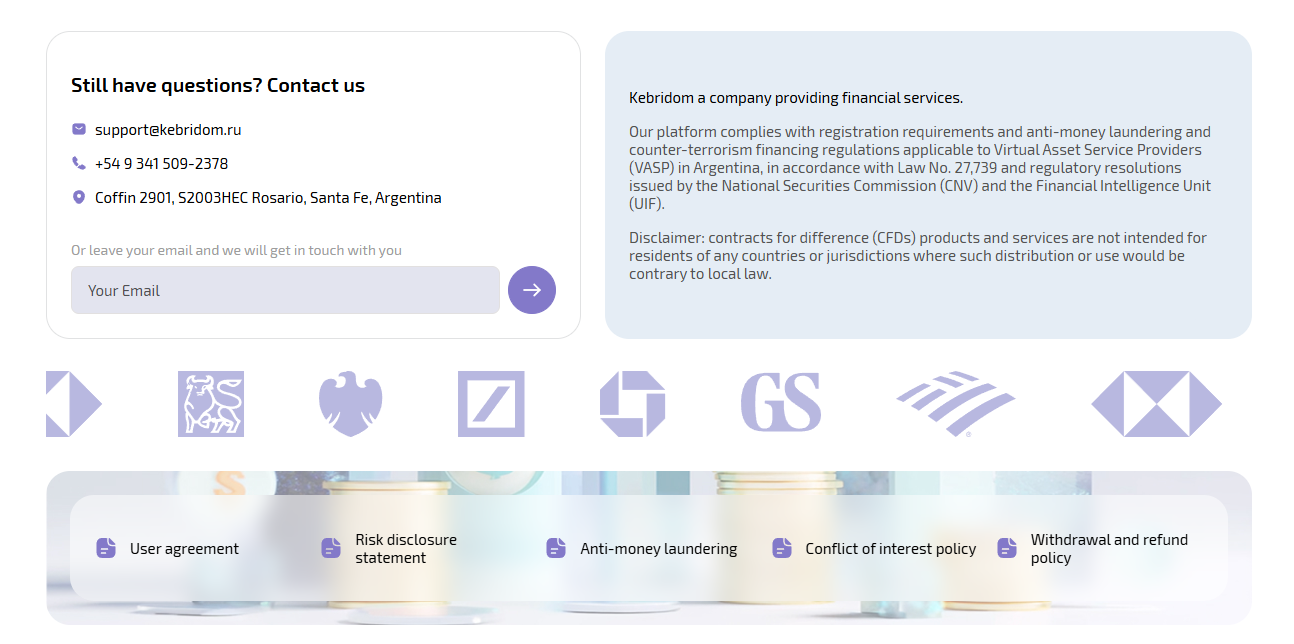
  • email – [email protected];
  • phone – +54 9 341 509-2378;
  • address – Coffin 2901, S2003HEC Rosario, Santa Fe, Argentina.

Clients can also contact managers through an online form on the website.

The support email address deserves particular attention. Verification of [email protected] through an email validation service showed that this mailbox is not registered. This may explain complaints from traders who report sending emails to support but receiving no response.

The physical address, Coffin 2901, S2003HEC, Rosario, Santa Fe, Argentina, does exist and can be found on the map. However, the area is predominantly occupied by one- and two-story residential buildings. No company geotags or other signs of Kebridom’s presence at this location could be identified.

Therefore, the existence of the broker’s office at the stated address could not be confirmed.

Kebridom Websites

Four domains are associated with the project:

  • kebridom.ru – the broker’s main presentation website;
  • keb-rdm.info – the client area and FinStation web trading terminal;
  • kebridom.com – an additional domain that was not working at the time of the check and returned a 502 error;
  • keb-ridom.ru – another client-area address that opens the same trading terminal as keb-rdm.info.

Separating a corporate website from a trading terminal is not unusual and can also be found among legitimate brokers. However, Kebridom does not explain who owns these resources or why several different domains are used to access the same client area.

Having several alternative addresses also makes it possible to quickly replace a client-area link if one of the resources stops working or accumulates a large number of negative mentions.

Kebridom Trading Conditions

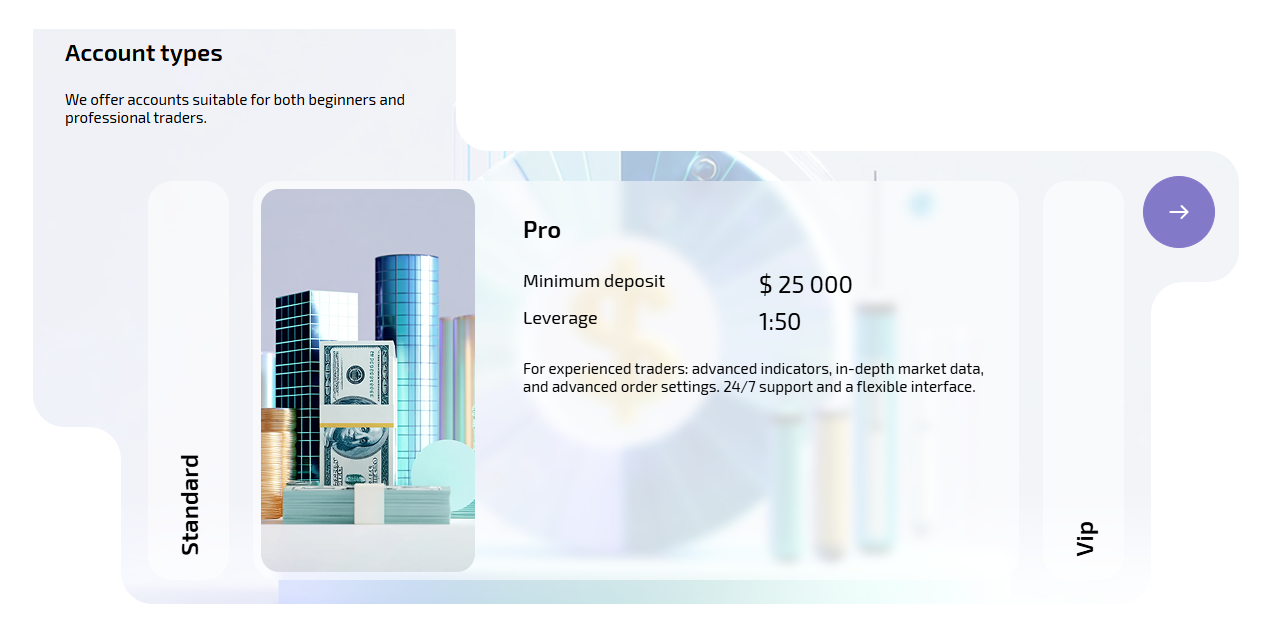
Kebridom offers clients three types of trading accounts. The minimum deposit is $1,000.

Standard – a deposit from $1,000, leverage of up to 1:20, and instant trade execution.

Pro – a deposit from $25,000 and leverage of up to 1:50. The account additionally includes claimed access to cryptocurrency operations, a PAMM account, and swap-free trading.

VIP – a starting deposit of $50,000 and maximum leverage of up to 1:100. The listed features include cryptocurrency trading, a PAMM account, ETF and index trading, insurance and investment protection, as well as a personal manager.

However, the broker does not disclose a number of important trading parameters. The website does not provide detailed information about spreads, trading commissions, swaps for Standard and VIP accounts, margin requirements, or the mechanism behind the claimed insurance.

Therefore, clients are asked to deposit up to $50,000, while the detailed terms governing the protection of these funds remain undisclosed.

The leverage of up to 1:100 is another point that raises questions. High leverage increases the potential risks for a trader. In addition, since 2018, retail clients in the EU have been subject to leverage restrictions, including a 1:30 limit for major currency pairs. Therefore, the trading conditions advertised by Kebridom require additional verification in terms of the applicable regulatory framework.

Kebridom Documents and Policies

The following documents are published on the website:

  • User Agreement;
  • Risk Disclosure Statement;
  • Anti-Money Laundering Policy;
  • Conflict of Interest Policy;
  • Withdrawal and Refund Policy.

The documents provide detailed information about trading risks, possible restrictions, and the user’s obligations. At the same time, the company’s own liability is described in considerably less detail.

As a result, the published policies primarily explain possible restrictions and situations in which the broker may not be responsible for losses, delays, technical failures, and other problems. This gives Kebridom considerable room to make its own decisions in disputed situations.

Withdrawals from Kebridom

To fund an account and receive funds through the FinStation terminal, the broker offers several methods:

  • transfers through cryptocurrency wallets;
  • bank transfers and payment cards;
  • international electronic payment systems.

However, it is impossible to determine in advance exactly how much money a client will receive upon withdrawal. The final conditions may only become clear after the withdrawal request has been submitted – at a point when the funds are already held by the broker and the trader’s ability to influence the situation becomes more limited.

Conclusion on Kebridom

The review of Kebridom raises several significant questions about the company. The broker claims to hold licenses from VFSC, DFSA, CSSF, and FCA, yet no supporting documents are published on the website, and searches of the official registers produced no results. Kebridom was also not found in the register of the Central Bank of Russia.

Additional questions concern the company’s contact and registration information. The stated support email failed verification, the physical presence of the company at the declared address could not be confirmed, and the ownership information for the main domain is hidden.

The kebridom.ru domain also deserves particular attention. It was registered only on June 11, 2026, which does not correspond with the company’s claim that it has been operating since 2018. The domain check also revealed several additional indicators that warrant caution.

The trading conditions cannot be considered fully transparent either. With a minimum deposit of $1,000, the broker does not disclose the full range of commissions and other important parameters, while maximum leverage reaches 1:100. Against this background, particular attention should be paid to client complaints concerning withdrawal problems and demands for additional payments.

Taken together, these factors do not allow Kebridom to be considered a transparent and demonstrably regulated broker. Until the company provides documentary evidence of its licenses, clear information about its legal entity, and convincing evidence regarding the handling of client funds, entrusting money to Kebridom appears risky.

Heyanyie Broker Review

Heyanyie presents itself as an international online broker providing access to global financial markets. According to the company’s website, clients can trade multiple asset classes, including forex currency pairs, cryptocurrencies, stocks, commodities, and indices. The platform also promotes additional services such as market analysis, educational materials, personal account managers, and investment solutions.

The broker claims to serve traders worldwide and highlights a large client base, significant trading volumes, and partnerships with financial institutions. Heyanyie also advertises advanced trading technology, fast execution, and access to professional tools designed for both beginner and experienced investors.

However, a detailed review of the available information reveals several areas that require further verification. Questions remain regarding the company’s legal status, regulatory authorization, website history, and transparency of operations.

This Heyanyie review examines the broker’s background, license claims, trading conditions, withdrawal policies, and customer feedback to determine whether the platform can be verified as a reliable financial service provider.

Company information and ownership

Heyanyie claims to operate as a global brokerage company with a registered presence in Argentina. The company lists an address connected with Maipú 701, Rosario, Santa Fe, Argentina.

However, publicly available information does not provide sufficient confirmation of a fully registered brokerage entity operating under the Heyanyie name. A legitimate financial company normally provides clear corporate details, including:

  • legal entity name;
  • registration number;
  • ownership structure;
  • executive information;
  • regulatory documentation;
  • official business records.

In the case of Heyanyie, information about the company’s owners and management team is limited. There is no clear explanation of who controls the platform or which legal entity is responsible for handling client funds.

The broker also claims to have been operating for several years, but available domain information appears inconsistent with this statement. According to domain analysis reports, the website activity does not fully match the company’s claimed history.

A lack of corporate transparency does not automatically prove illegal activity, but it represents a significant concern when evaluating an online broker that accepts client deposits.

License and regulation

Regulation is one of the most important factors when assessing the reliability of a broker. Licensed financial companies are required to follow strict rules regarding client protection, financial reporting, risk management, and operational procedures.

Heyanyie claims to operate under international financial standards and references several major regulatory organizations, including:

  • Financial Conduct Authority (FCA);
  • Dubai Financial Services Authority (DFSA);
  • Commission de Surveillance du Secteur Financier (CSSF);
  • Vanuatu Financial Services Commission (VFSC).

However, these regulatory claims cannot be independently verified through official regulator databases.

A legitimate broker license should normally include:

  • a verifiable license number;
  • matching company details;
  • confirmation through the regulator’s official website;
  • information about permitted financial activities.

During the review process, no confirmed authorization was found proving that Heyanyie is licensed to provide brokerage services by the mentioned regulators.

The company also does not provide sufficient information about investor protection programs, client compensation schemes, or supervision by an independent financial authority.

Another important point is that brokers offering services to clients in certain jurisdictions may require additional authorization from local regulators. No evidence confirming such permissions has been identified.

Based on the available information, Heyanyie cannot be verified as a regulated financial provider.

Website analysis

The official website associated with Heyanyie is heyanyie.com. Other related domains, including heya-nyie.co and heya-ny.ltd, have also been linked to the project.

At first glance, the website appears professionally designed and contains typical sections found on online brokerage platforms. The site presents information about trading services, account options, market access, and investment opportunities.

However, several technical and transparency issues raise concerns.

Domain analysis indicates that the online presence does not fully correspond with the company’s claimed operational history. Available records show that the domain was registered earlier but underwent changes, including ownership updates.

Additional warning signs include:

  • hidden WHOIS ownership information;
  • limited details about the company behind the website;
  • multiple similar domain names;
  • lack of verified corporate history.

Professional brokers usually maintain a transparent digital footprint, including verified company profiles, regulatory references, corporate announcements, and long-term website history.

The trading platform promoted by Heyanyie also requires attention. The broker refers to the MarketNode trading environment. The existence of a trading terminal alone does not confirm that a company operates as a legitimate broker. A regulated provider should also disclose information about technology partners, liquidity providers, execution systems, and security procedures.

Trading conditions

Heyanyie offers access to several financial markets, including:

  • forex currency pairs;
  • cryptocurrencies;
  • stocks;
  • commodities;
  • indices;
  • CFD instruments.

The broker advertises multiple account types designed for different levels of traders.

Available information suggests that the platform offers:

  • beginner accounts starting from approximately $150;
  • advanced accounts requiring around $5,000;
  • VIP accounts with deposits of approximately $25,000.

The broker also promotes leverage of up to 1:500.

High leverage is one of the most important risk factors in retail trading. While some offshore brokers provide high leverage levels, regulated jurisdictions often limit leverage because excessive exposure can lead to rapid account losses, especially among inexperienced traders.

Heyanyie also advertises additional services, including:

  • personal trading managers;
  • market signals;
  • educational webinars;
  • investment products;
  • cryptocurrency staking opportunities.

The company reportedly promotes staking returns of around 60% annually or higher. Such offers require careful evaluation because unusually high returns should always be supported by transparent explanations of risk, investment strategy, and asset management procedures.

Information about important trading details, including liquidity providers, spreads, execution quality, and commission structures, is limited. This makes it difficult to compare the broker’s conditions with those offered by established regulated companies.

Terms and withdrawal rules

A broker’s legal documents are an important indicator of how client relationships are managed. Reliable financial companies usually provide detailed agreements covering:

  • account registration;
  • KYC verification;
  • AML procedures;
  • withdrawal conditions;
  • dispute resolution;
  • client protection measures.

Heyanyie provides limited information regarding its legal framework and internal policies.

One of the main areas requiring attention is the withdrawal process. According to available reports, some users experienced difficulties when attempting to access their funds. Complaints mention additional payment requests, including possible fees, verification costs, or other requirements before withdrawals could be processed.

Such practices represent a significant risk because legitimate brokers normally explain all withdrawal requirements before accepting client deposits.

Another concern is the absence of detailed information about how client funds are stored, whether accounts are separated from company operating funds, and whether external audits are conducted.

Without clear documentation, clients have limited ability to evaluate how their deposits are protected.

Withdrawal problems and client complaints

Customer feedback is an important part of any broker investigation. Reviews associated with Heyanyie describe several recurring issues related to withdrawals and communication with representatives.

Common complaints include:

  • inability to withdraw funds;
  • requests for additional payments before withdrawal approval;
  • account restrictions after withdrawal attempts;
  • pressure to increase deposits;
  • aggressive communication from account managers.

Some reported cases describe a similar pattern:

  1. A client registers on the platform.
  2. Representatives contact the trader and encourage an initial deposit.
  3. The account appears to generate positive results.
  4. The client is encouraged to invest larger amounts.
  5. Withdrawal requests become difficult or delayed.
  6. Additional requirements are introduced.

Individual online complaints should always be reviewed carefully, as user experiences can vary. However, repeated reports describing similar withdrawal problems represent an important factor when assessing broker reliability.

A trustworthy financial company should provide a clear and predictable withdrawal process without unexpected conditions.

Warning signs

The following factors represent the main risk indicators identified during the Heyanyie review:

  • no independently verified brokerage license;
  • unclear company ownership structure;
  • limited legal information;
  • regulatory claims that cannot be confirmed;
  • inconsistent company history;
  • hidden domain ownership details;
  • use of multiple related websites;
  • extremely high leverage options;
  • unclear trading infrastructure;
  • limited information about client fund protection;
  • complaints regarding withdrawal difficulties;
  • aggressive investment promotion methods.

The presence of multiple warning signs does not by itself establish illegal activity. However, their combination indicates that potential clients should exercise caution and perform additional verification before depositing funds.

Final thoughts

The review of Heyanyie shows several areas that raise concerns regarding the broker’s transparency and regulatory status. Although the platform presents itself as an international trading provider with access to global financial markets, important elements of its operation remain difficult to verify.

The lack of confirmed licensing, limited ownership information, unclear corporate structure, and withdrawal-related complaints create uncertainty about the safety of using the platform.

Trading conditions such as high leverage and attractive investment opportunities may appear appealing, but they require careful evaluation when they are offered by a company without clearly confirmed regulation.

Based on the available information, Heyanyie demonstrates several characteristics commonly associated with high-risk brokerage platforms. Potential users should verify all regulatory claims through official sources and carefully review the company’s legal documentation before committing funds.

At this stage, Heyanyie cannot be fully verified as a regulated financial provider, and the available evidence suggests that traders should approach the platform with a high level of caution.

ABID Ltd Broker Review

ABID Ltd presents itself as an international financial brokerage company offering access to multiple investment markets through the website globaladibmarkets.com. According to the information published by the platform, clients can trade various asset classes, including currencies, stocks, commodities, cryptocurrencies, indices, metals, bonds, and CFD instruments.

The company positions its services as suitable for both beginner and experienced traders, highlighting modern trading technology, fast order execution, access to global markets, and customer support. The broker also claims to provide opportunities related to Islamic financial standards and mentions access to exchanges in the UAE, Saudi Arabia, and the United States.

At first glance, the platform uses standard elements commonly associated with online brokers: a web-based trading terminal, mobile access, market instruments, and investment-related services. However, a detailed review of publicly available information raises questions regarding the company’s legal status, regulatory background, and overall transparency.

A key issue is that many important details typically provided by established financial providers are either unavailable or cannot be independently verified. This includes corporate ownership information, confirmed licensing details, complete trading conditions, and transparent withdrawal procedures.

For potential clients, these factors are important because a broker’s reliability depends not only on the appearance of its website but also on verifiable legal documentation, regulatory oversight, and clear operational rules.

Company information and ownership

ABID Ltd provides limited information about its corporate structure. The website states that the company operates as a global financial intermediary, but it does not provide sufficient details about the legal entity behind the platform.

Information that remains unclear includes:

  • the exact jurisdiction of registration;
  • official company registration number;
  • names of company directors or owners;
  • corporate history supported by documents;
  • details of the entity responsible for client agreements.

The broker claims to have been operating since 2014. However, publicly available information does not provide reliable evidence confirming this history. The domain associated with the platform appears to have been registered much later, which creates a discrepancy between the claimed operational period and the available online footprint.

Another issue relates to company addresses. ABID Ltd references addresses connected with offshore jurisdictions, including the British Virgin Islands and Saint Vincent and the Grenadines. However, these details do not provide sufficient confirmation of an actual operational office or regulated brokerage structure.

One address listed by the company corresponds to a real location, but available information does not confirm that it belongs to ABID Ltd or represents a functioning office of the broker.

There is also a company with the same name registered in the United Kingdom. However, this entity operates in a different business sector and cannot be linked to the brokerage platform based only on the identical name.

A legitimate financial company usually provides clear ownership details, registration documents, and information about the legal entity responsible for customer funds. The lack of such information makes it difficult to verify the corporate background of ABID Ltd.

License and regulation

Regulation is one of the most important factors when assessing an online broker. Licensed financial providers are generally required to meet specific standards regarding customer protection, reporting, capital requirements, and business conduct.

ABID Ltd claims a connection with the UAE Securities and Commodities Authority (SCA) and references license number 604041. However, verification of this information raises concerns because the mentioned license number appears to belong to another company, ADIB Securities.

The available information does not confirm that globaladibmarkets.com is operated by ADIB Securities or that the referenced authorization applies to ABID Ltd.

This distinction is important. A broker cannot rely only on mentioning another regulated company or license number. The regulated entity, website domain, legal agreements, and customer relationship must clearly match.

Additional checks indicate that the company does not provide a verifiable regulatory profile containing:

  • a confirmed regulator entry;
  • a legal entity name connected with the license;
  • official authorization documents;
  • information about investor protection mechanisms.

The absence of independently confirmed regulatory information means that ABID Ltd cannot currently be verified as a regulated financial provider.

This does not automatically prove unlawful activity, but it represents a significant transparency issue. Traders should be cautious when a broker provides financial services while its regulatory status remains unclear.

Website analysis

The official website of the project is globaladibmarkets.com. The resource is structured as a relatively simple landing page containing general information about services, financial products, and company positioning.

A technical review of the website reveals several points requiring attention.

The domain was registered on March 23, 2026. This indicates that the online presence of the platform is relatively new. At the same time, the company claims years of experience dating back to 2014, which does not correspond with the available domain history.

Other domain-related details include:

  • ownership information hidden through WHOIS privacy protection;
  • hosting infrastructure connected with Cloudflare;
  • no confirmed historical versions of the website available through public archives.

Using Cloudflare is common among both legitimate and less transparent websites, so this factor alone does not indicate a problem. However, when combined with missing ownership information and limited company history, it reduces the ability to independently evaluate the platform.

Another point is the limited amount of publicly available documentation. A well-established broker usually provides detailed information about its corporate structure, regulatory licenses, trading infrastructure, and client protection policies.

The absence of a significant online history also makes it difficult to confirm whether the platform has operated for the period claimed by the company.

Trading conditions

ABID Ltd advertises access to a broad selection of financial instruments. The available categories reportedly include:

  • forex markets;
  • cryptocurrencies;
  • stocks;
  • commodities;
  • indices;
  • metals;
  • CFD contracts.

However, the broker does not provide complete trading specifications before account registration.

Information that is not clearly disclosed includes:

  • available account types;
  • minimum deposit requirements;
  • leverage limits;
  • spreads;
  • trading commissions;
  • swap rates;
  • margin requirements;
  • stop-out levels.

This lack of information makes it difficult for potential clients to evaluate the actual cost of trading or compare the service with other brokers.

A transparent brokerage company normally publishes detailed trading conditions because these parameters directly affect client decisions. Traders should be able to understand potential fees and risks before opening an account and depositing funds.

ABID Ltd also promotes access to a proprietary trading terminal and mobile solutions. However, there is limited publicly available information regarding the technology behind the platform, liquidity providers, order execution model, or whether prices can be independently verified.

Without detailed technical information, clients have limited ability to assess how trades are executed and whether the platform operates according to standard industry practices.

Terms and withdrawal rules

The broker provides several standard legal documents, including privacy policies, risk disclosures, terms and conditions, and AML-related information.

However, the available documents contain mostly general descriptions and do not provide complete clarity regarding several important areas.

Missing details include:

  • dispute resolution procedures;
  • customer compensation mechanisms;
  • protection of client funds;
  • specific withdrawal requirements;
  • responsibilities of the legal entity providing services.

Withdrawal procedures are especially important for evaluating any financial platform. ABID Ltd does not publicly disclose complete information about:

  • supported payment methods;
  • processing times;
  • withdrawal fees;
  • transaction limits;
  • specific verification requirements.

The broker mentions KYC and AML procedures, which are common in the financial industry. However, customers should understand exactly how these procedures work before depositing funds.

Another area requiring attention is the possibility of additional payment requirements during withdrawal. In the online brokerage sector, demands to pay separate fees, taxes, insurance charges, or account activation costs before releasing funds are considered a significant risk indicator.
Legitimate brokers generally deduct applicable fees according to published conditions rather than requiring unexpected payments before processing withdrawals.

Withdrawal problems and client complaints

Public feedback about ABID Ltd is limited. The broker does not appear to have an established reputation on major independent review platforms, which may be partly related to the relatively recent appearance of the website.

At the same time, online discussions and reviews contain complaints from users who report difficulties associated with withdrawing funds.

The most common issues mentioned include:

  • delayed withdrawal processing;
  • additional payment requests;
  • problems completing account verification;
  • reduced communication after larger deposits;
  • pressure from representatives to increase investment amounts.

Some users describe situations where managers actively encouraged them to deposit additional funds by promising improved trading opportunities or higher potential returns.

There are also reports connected with cryptocurrency deposits. While digital asset payments are widely used in modern finance, they generally provide fewer opportunities for transaction reversals compared with traditional banking methods.

Customer complaints alone do not prove misconduct by a company. However, when combined with limited regulatory information and unclear withdrawal procedures, they represent additional factors that potential clients should carefully consider.

Warning signs

The review of ABID Ltd identifies several factors that require additional caution:

  • The regulatory status of the broker cannot be independently verified.
  • The mentioned license information appears connected with another company.
  • The company’s claimed history does not match available domain information.
  • The website domain was registered recently.
  • Ownership details are hidden.
  • Legal information about company structure is limited.
  • Office addresses cannot be fully confirmed as belonging to the broker.
  • Trading conditions are not transparently disclosed.
  • Withdrawal procedures lack important details.
  • Online complaints mention difficulties with account withdrawals and additional payment requests.

Each point should be evaluated separately. However, together these factors indicate a higher level of uncertainty compared with established regulated brokers.

Final thoughts

ABID Ltd presents itself as a global brokerage platform offering access to multiple financial markets. The company uses a familiar structure and promotes services commonly associated with online trading providers.

However, a review of available information highlights several unresolved issues related to regulation, ownership transparency, website history, and trading conditions.

The broker’s claimed license cannot be clearly linked to the platform, corporate information remains limited, and important details about fees, accounts, and withdrawals are not fully disclosed.

Based on the available evidence, ABID Ltd shows signs of a high-risk broker that requires additional verification before any financial commitment is made. Potential clients should carefully review legal documents, confirm regulatory authorization, and verify how funds are stored and withdrawn.

Until the company provides clearer evidence of regulation and operational transparency, cooperation with the platform should be approached with caution.

Zequipco Broker Review

Zequipco presents itself as an international online trading provider offering access to multiple financial markets through a digital trading platform. According to the information published on its website, the broker provides access to Forex currency pairs, cryptocurrencies, stocks, indices, commodities, and precious metals.

The company promotes itself as a platform designed for both beginner and experienced traders. It highlights a wide range of trading instruments, modern technology, fast execution, and access to global markets. The broker also claims to provide a proprietary trading environment available through a web-based terminal and mobile solutions.

At first glance, the platform appears structured similarly to many established online brokers. The website contains information about trading opportunities, account options, and regulatory claims intended to create confidence among potential clients.

However, a closer review of the available information reveals several areas that require additional verification. The main concerns relate to the company’s legal identity, regulatory status, website transparency, and withdrawal conditions reported by some users.

Before considering any financial provider, traders should verify whether the company is officially registered, authorized by a recognized regulator, and operating under clear legal requirements.

Company information and ownership

Zequipco states that it operates under the name Zequipco Limited Company and indicates a registered address in Argentina:

Blvd. Pres. Dr. Arturo U. Illia 198, X5000ASO Cordoba, Argentina.

However, publicly available information does not provide sufficient evidence confirming the existence of an active financial company operating from this location. The ownership structure, company directors, and corporate background are not clearly disclosed.

For a financial services provider, transparency regarding ownership and legal structure is an important factor. Regulated brokers usually publish detailed corporate information, including registration numbers, licensing details, responsible entities, and official contact information.

In the case of Zequipco, there is limited information available regarding the individuals or organizations behind the platform. The absence of verifiable ownership details makes it difficult to assess who is responsible for providing financial services and handling client funds.

The company also claims to serve international clients, but there is no clear explanation regarding which jurisdictions it operates in or which legal framework governs its activities.

A lack of transparency does not automatically prove wrongdoing, but it represents a significant factor that traders should consider when evaluating the reliability of a broker.

License and regulation

One of the most important aspects of broker verification is confirming whether the company holds valid authorization from recognized financial regulators.

Zequipco claims to be regulated by several international authorities, including:

  • Financial Conduct Authority (FCA) in the United Kingdom;
  • Dubai Financial Services Authority (DFSA);
  • Commission de Surveillance du Secteur Financier (CSSF) in Luxembourg;
  • Vanuatu Financial Services Commission (VFSC).

However, these regulatory claims could not be independently verified through official regulator databases.

During the review process, concerns were identified regarding the links provided as evidence of licensing. Instead of directing users to official regulator websites, some references appear to lead to alternative domains that imitate official pages.

A legitimate broker license should always be independently confirmed through the official website of the relevant regulatory authority. Traders should not rely only on information displayed on a broker’s own website.

Additionally, there is no publicly available evidence confirming that Zequipco holds authorization to provide investment services in major financial jurisdictions.

The lack of verifiable licensing information means the broker cannot currently be confirmed as a regulated financial provider. This creates additional uncertainty regarding client protection measures, dispute resolution procedures, and oversight of company operations.

Website analysis

The official website of the broker operates under the domain zequipco.com. The platform also uses a separate domain, zequi-po.pro, which appears to be connected with account access and trading functionality.

A domain history check shows that the main domain has existed for several years. However, domain registration age alone does not prove the operational history of a financial company. Older domains can sometimes be reused or repurposed for new projects.

Available website information suggests that the current trading operation became active much later than the original domain registration date. This difference between domain age and business activity may create an inaccurate impression of long-term market experience.

Another point requiring attention is the use of multiple domains. Established financial companies usually maintain a clear and consistent online infrastructure. The use of separate websites for marketing materials, client access, and trading terminals can make verification more difficult.

The website also provides limited information about company management, infrastructure providers, and operational history. These elements are normally expected from brokers that handle client deposits and provide financial services.

Overall, the website creates the appearance of a professional trading platform, but several technical and transparency-related aspects require further confirmation.

Trading conditions

Zequipco advertises access to a broad selection of financial instruments, including:

  • Forex currency pairs;
  • cryptocurrencies;
  • stocks;
  • market indices;
  • commodities;
  • precious metals.

The broker provides trading through CFD contracts. CFDs allow traders to speculate on price movements without owning the underlying asset. While CFDs are widely used in financial markets, they also involve significant risks due to leverage and market volatility.

The platform claims to offer leverage of up to 1:500. Such leverage levels are considerably higher than restrictions applied by many regulated jurisdictions for retail traders. For example, European regulators typically impose much lower leverage limits to reduce client exposure.

The minimum deposit reportedly starts from $100, making the service accessible to beginners. However, the availability of low entry requirements does not necessarily indicate reliability, especially when combined with limited regulatory transparency.

The broker presents its own trading platform rather than widely recognized third-party solutions. A proprietary platform is not automatically a problem, but traders should consider whether the system has independent verification, technical documentation, and a proven operational history.

Information regarding spreads, commissions, and execution conditions is also limited. Some available reviews mention wide spreads on major currency pairs, which may affect trading costs.

Before opening an account, clients should carefully review all available trading conditions and compare them with established regulated providers.

Terms and withdrawal rules

Withdrawal policies are one of the most important areas when assessing an online broker.

Zequipco states that clients can deposit and withdraw funds through several payment methods, including bank cards, electronic payment systems, and cryptocurrencies. However, user reports indicate that actual payment options may differ depending on account access and region.

The broker requires customers to complete identity verification procedures, including providing personal documents and payment information. KYC and AML checks are standard practices in the financial industry and are required by legitimate brokers.

However, concerns may arise if verification procedures are used as a reason for prolonged delays or restrictions on withdrawals.

The company’s user agreement reportedly includes clauses allowing it to delay or restrict transactions under certain circumstances. Some sections also mention possible additional requirements related to trading activity or account conditions.

Traders should pay close attention to withdrawal rules before depositing funds. Conditions involving additional payments, unclear requirements, or broad company discretion may create unnecessary risks for clients.

A transparent broker should clearly explain withdrawal processing times, applicable fees, verification requirements, and situations where transactions may be restricted.

Withdrawal problems and client complaints

Online feedback related to Zequipco includes complaints from users who report difficulties accessing funds and completing withdrawals.

Some clients claim that after requesting withdrawals they were asked to provide additional payments described as taxes, commissions, or other charges. Other reviews mention account restrictions and communication difficulties after withdrawal requests were submitted.

Patterns reported by some users include:

  • delays in processing withdrawal requests;
  • requests for additional payments before funds can be released;
  • increased pressure from account representatives to make additional deposits;
  • reduced communication after clients request withdrawals.

Individual reviews cannot independently confirm the overall operation of a broker. However, repeated complaints with similar descriptions should be considered when evaluating potential risks.

A reliable financial provider should have a transparent withdrawal process, accessible customer support, and clear procedures for resolving disputes.

Warning signs

Several factors identified during the review indicate areas of concern that potential clients should carefully evaluate:

  • lack of independently verified regulatory authorization;
  • unclear ownership and corporate structure;
  • limited information about company management;
  • inability to confirm claimed licenses through official regulator databases;
  • use of multiple domains connected with the platform;
  • significant difference between domain history and claimed operational experience;
  • unusually high leverage levels;
  • limited transparency regarding trading conditions;
  • complaints regarding withdrawal difficulties;
  • unclear requirements related to additional payments or account restrictions.

These points do not represent a definitive conclusion about the company’s intentions, but together they indicate that additional caution is necessary before committing funds.

Final thoughts

The review of Zequipco highlights several areas that require careful consideration. While the broker presents itself as an international trading platform offering access to multiple markets, important aspects of its operation remain difficult to verify.

The main concerns relate to regulatory status, ownership transparency, licensing claims, and reported withdrawal issues. A financial company handling client funds should provide clear evidence of registration, valid authorization, and transparent operating procedures.

At this stage, Zequipco cannot be independently confirmed as a regulated financial provider. Potential clients should carefully verify all available information, review legal documentation, and consider the risks associated with using a platform that lacks clear regulatory confirmation.

Choosing a broker with verified licensing, transparent ownership, and established oversight remains one of the most important steps in protecting trading capital.