
BitNest Review
BitNest presents itself as a decentralized crypto-financial ecosystem where users can deposit digital assets and generate passive income through smart-contract-based products.
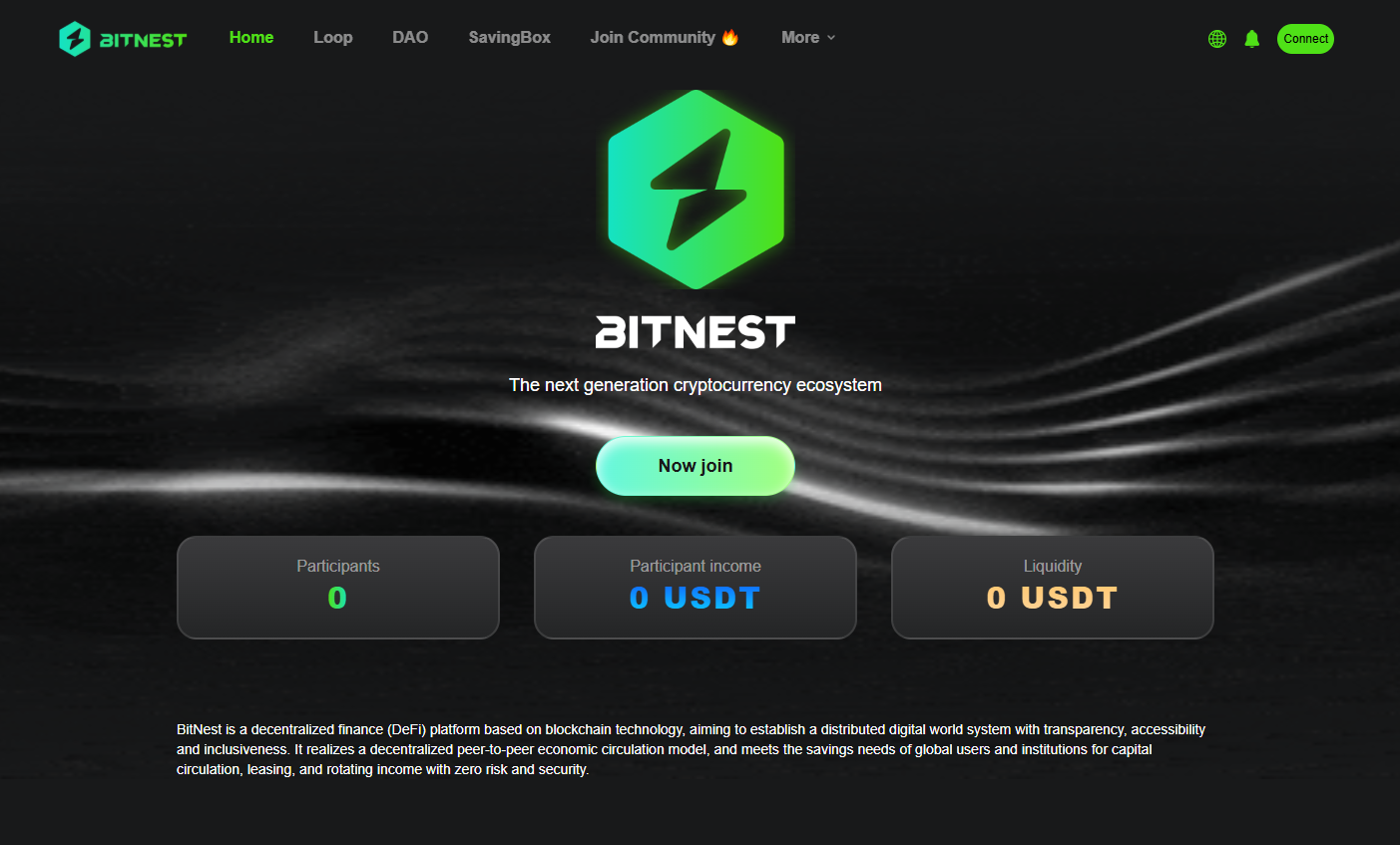
The platform promotes fixed returns, including a daily rate of 0.4% through Saving Box and returns of up to 24% over 28 days through BitLoop. At the same time, BitNest provides limited information about its legal entity, registration, licensing, and the source of the promised returns.
This combination makes BitNest a high-risk crypto investment platform rather than a conventional regulated cryptocurrency exchange.
What Is BitNest?
BitNest describes itself as a decentralized platform for managing digital assets and accessing different income-generating products. Instead of opening a traditional brokerage account, users connect a cryptocurrency wallet such as MetaMask and interact with the platform through blockchain transactions.
According to the available information, BitNest was launched in 2023. However, the platform does not provide clear corporate information confirming the legal entity behind the service, its jurisdiction, or financial licenses. A physical business address is also not disclosed.
The lack of corporate transparency is important because users placing funds into an investment product need to know who operates the platform and what legal protections are available if something goes wrong.
How Does BitNest Work?
BitNest uses a non-custodial wallet-based model.
The general process is straightforward:
- The user opens the BitNest website.
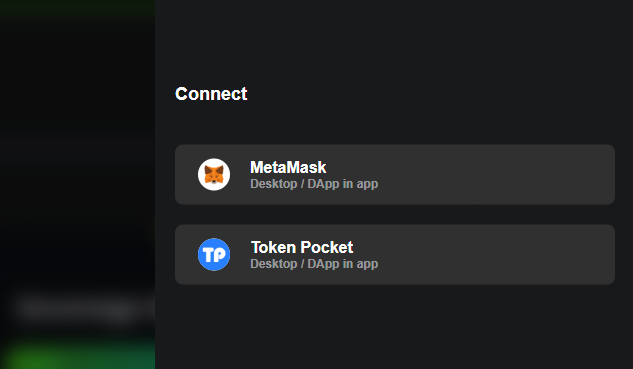
- A cryptocurrency wallet, such as MetaMask, is connected.
- The user selects an available product.
- The amount of USDT to be deposited is specified.
- The transaction is confirmed directly in the wallet.
- According to BitNest, subsequent calculations and returns are determined by smart-contract logic.
This model means BitNest does not function like a traditional centralized exchange where users maintain a conventional account balance.
However, decentralization does not automatically make a platform safe. The actual risks depend on the smart contracts, their permissions, liquidity, economic model, and the people or entities controlling the surrounding infrastructure.
Users also remain responsible for their wallets. Losing a seed phrase or access to a wallet cannot normally be resolved by BitNest support.
BitNest Investment Products
BitNest offers several products designed to generate returns from deposited crypto assets.
The two most prominent are Saving Box and BitLoop.
Saving Box
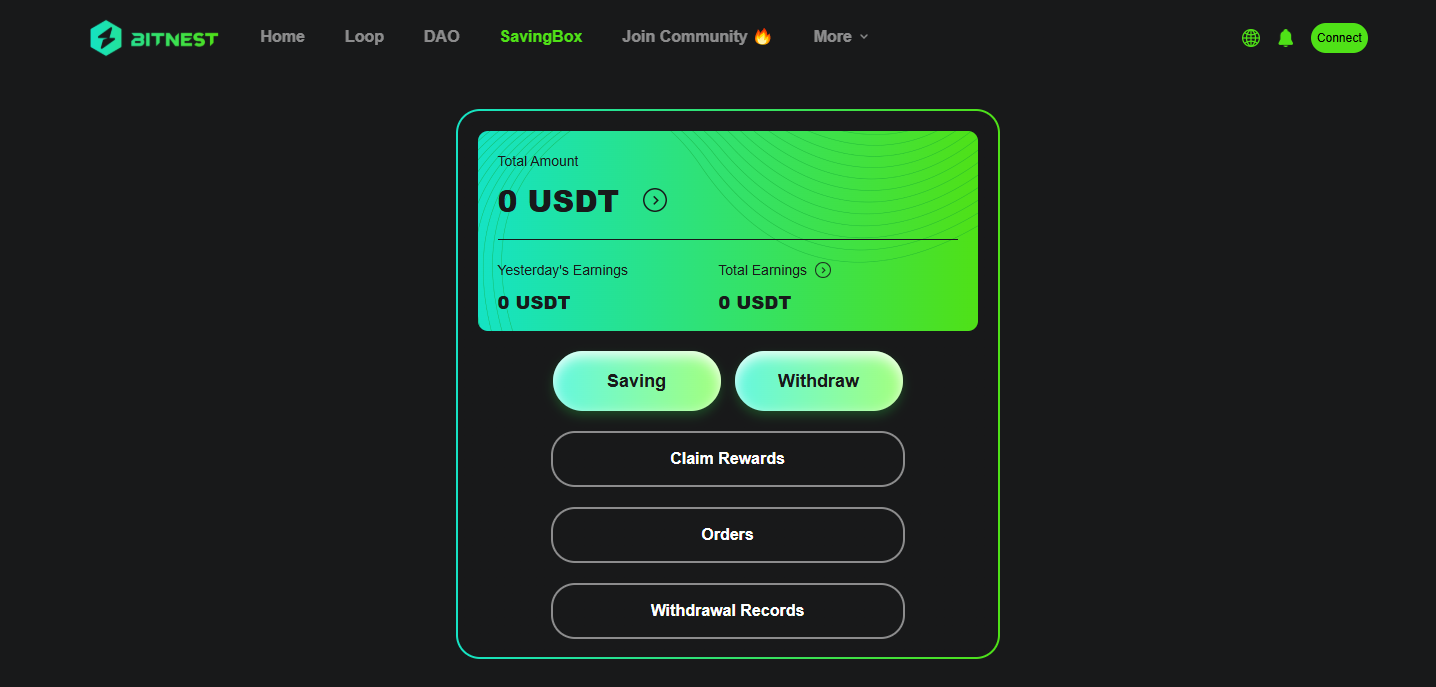
Saving Box is presented as a DeFi product connected to PancakeSwap.
Users deposit USDT and are promised a fixed daily return of 0.4%. The platform states that deposits can be made without a minimum amount and that funds can be deposited or withdrawn at any time. A fixed withdrawal fee of 0.1 USDT is also mentioned, excluding blockchain network fees.
The 0.4% daily rate deserves particular attention.
In conventional DeFi protocols, yields normally fluctuate according to liquidity, trading activity, borrowing demand, fees, and other market conditions. A fixed daily return therefore requires a clear explanation of where the money comes from and how the platform can maintain the promised rate.
Without sufficient information about the underlying revenue mechanism, the stated return cannot be treated as a conventional low-risk yield.
BitLoop
BitLoop is structured around predefined investment periods ranging from one to 28 days.
The stated returns are:
- 1 day – 100.4% repayment
- 7 days – 104%
- 14 days – 109.5%
- 28 days – 124%
For example, a 1,000 USDT placement for 28 days would theoretically result in a 1,240 USDT return under the stated conditions.
The main issue is not simply the size of the return. It is the lack of sufficient publicly available information explaining the economic mechanism behind it.
An investment product promising a predetermined return needs a sustainable source of revenue capable of financing those payments. BitNest’s public materials do not provide enough detail to independently verify this mechanism.
Bitnest Savings and Bitnest DAO
BitNest also promotes Bitnest Savings and Bitnest DAO.
Bitnest Savings is described as a tool for holding crypto assets, but the publicly available information provides limited detail about its exact terms, limits, and calculation mechanism.
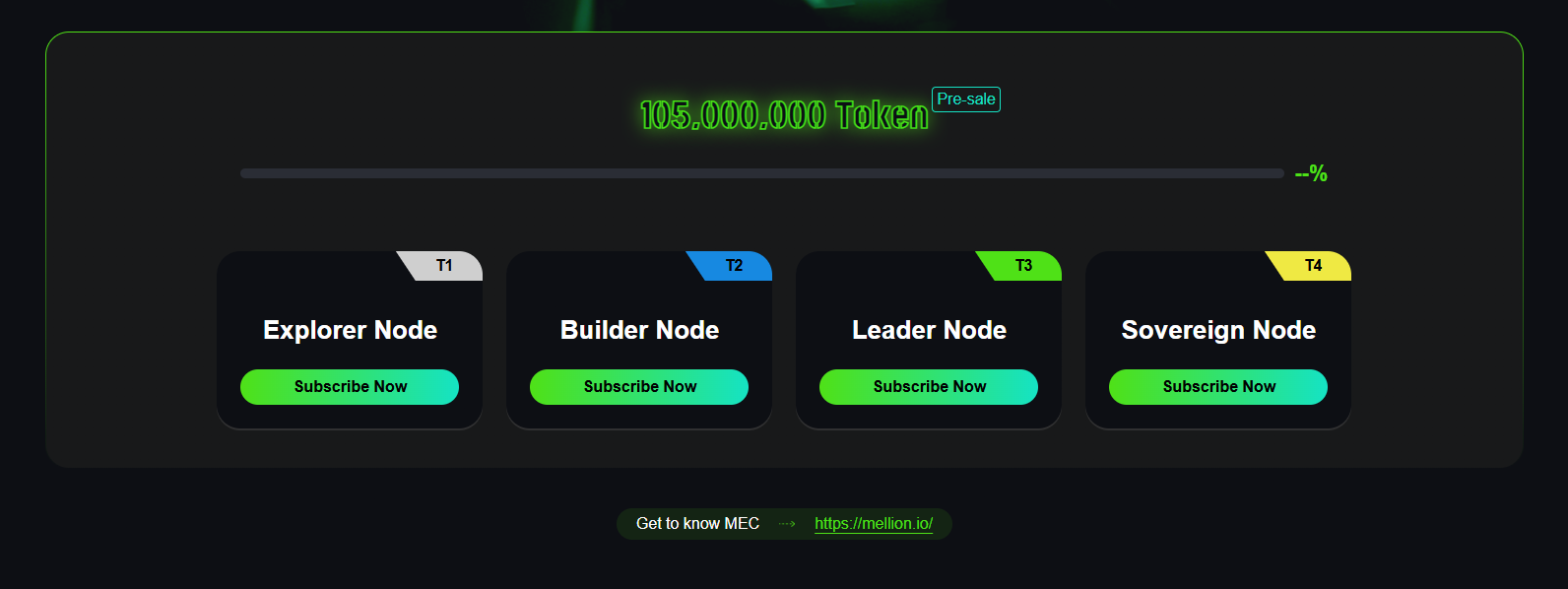
Bitnest DAO is associated with the project’s internal economy and the distribution of MellionCoin. However, the available materials do not provide sufficient financial or legal information to fully assess this structure.
This creates another area of uncertainty because the value of an internal token depends on its actual utility, liquidity, supply mechanics, and external demand.
MellionCoin
MellionCoin is BitNest’s internal cryptocurrency token.
Having a native token is not inherently suspicious. Many legitimate blockchain projects have their own tokens.
The relevant question is what role the token plays in the ecosystem and whether it has meaningful independent liquidity.
If bonuses or other forms of compensation are paid in an internal token rather than a widely traded asset such as USDT, users face an additional market risk. A nominal balance in an internal token does not necessarily represent an equivalent amount of withdrawable cash.
BitNest Referral Program
BitNest also operates a multi-level referral system.
The program reportedly contains up to 17 levels. The first level offers a 20% reward based on the income generated by referred participants. Lower levels receive smaller percentages, including 10%, 5%, 3%, and 1% depending on the level.
A referral program alone does not prove that a project is a pyramid scheme. However, a 17-level structure becomes relevant when combined with fixed investment returns.
The more strongly participant rewards depend on bringing new users into the system, the more important it becomes to determine whether returns are generated by an actual underlying business activity or primarily supported by continued participant inflows.
Deposits and Withdrawals
BitNest uses cryptocurrency wallets rather than conventional bank transfers.
To deposit funds, users connect their wallet, select a product, enter the amount of USDT, and approve the blockchain transaction. The available information states that deposits can start from 1 USDT.
Withdrawals are also performed through the connected wallet.
For Saving Box, BitNest states that a 0.1 USDT withdrawal fee applies in addition to the blockchain network fee.
The publicly available product descriptions do not fully explain every withdrawal scenario, particularly the conditions surrounding early withdrawals from certain products.
This is an important consideration because access to deposited funds is just as important as the advertised return.
Is BitNest Regulated?
There is no sufficient evidence in the available materials confirming that BitNest operates under a recognized financial regulator.
The platform does not clearly disclose its legal entity, jurisdiction, registration details, or financial licenses.
For a decentralized protocol, the absence of a traditional financial license does not automatically establish illegal activity. However, the issue becomes more significant when the platform accepts crypto deposits, promotes fixed returns, and operates a multi-level referral structure.
Users should therefore distinguish between two separate concepts:
Blockchain transparency means that certain transactions or smart-contract interactions may be visible on-chain.
Corporate transparency means knowing who operates the platform, where it is registered, and what legal obligations apply to it.
BitNest provides the former infrastructure but limited evidence of the latter.
BitNest Security
BitNest relies heavily on smart contracts and wallet interactions.
This creates several separate risk categories.
Smart-contract risk. Bugs or vulnerabilities can result in the loss of assets. An audit, where available, does not guarantee that a contract is completely secure.
Wallet risk. Users are responsible for their private keys and transaction approvals.
Phishing risk. Fake BitNest domains or malicious interfaces can be used to trick users into signing unauthorized transactions.
Liquidity risk. A platform may display balances or promised returns without guaranteeing that sufficient liquid assets are available for all withdrawals.
The available materials specifically note that an audit should not be interpreted as proof that all smart-contract vulnerabilities have been eliminated.
BitNest Reviews and User Complaints
Available reviews contain complaints concerning withdrawals, account restrictions, delayed payments, and additional payment requests.
These reports should not be treated as conclusive proof of fraud by themselves. User reviews can be inaccurate, incomplete, or impossible to independently verify.
Nevertheless, withdrawal complaints are particularly relevant for an investment platform. If users are asked to deposit additional funds before they can access previously deposited money or supposedly earned returns, this should be treated as a major warning sign.
Main BitNest Red Flags
Several risk factors appear simultaneously.
Limited corporate transparency. BitNest does not provide sufficient information about its legal operator, registration, or licensing.
High fixed returns. Saving Box advertises 0.4% per day, while BitLoop advertises up to 24% over 28 days.
Multi-level referrals. The referral structure reportedly extends to 17 levels, with 20% available at the first level.
Unclear source of yield. Public materials do not provide enough information to independently verify how the promised returns are generated.
Internal token exposure. MellionCoin introduces an additional layer of liquidity and valuation risk.
Smart-contract exposure. Using DeFi infrastructure introduces technical risks that cannot be eliminated simply by describing the platform as decentralized.
Withdrawal complaints. Available user reports include allegations of blocked withdrawals and requests for additional payments.
Final Verdict on BitNest
BitNest should not be viewed as a conventional regulated crypto exchange.
Its core offering is built around investment products promising predetermined returns rather than standard spot cryptocurrency trading. The platform combines fixed yields, smart-contract-based deposits, an internal token, and a multi-level referral program.
The biggest concern is the combination of these features with limited corporate transparency. BitNest does not provide enough publicly verifiable information about its legal operator, licensing, or the economic source of its promised returns.
This does not by itself establish that BitNest is fraudulent. It does, however, mean that the platform carries a substantially higher level of counterparty, technical, liquidity, and model risk than a transparent, established, regulated financial service.
For investors, the key issue is therefore not whether BitNest calls itself decentralized. The relevant question is whether the platform can transparently demonstrate how it generates the returns it promises and under what legal and technical framework users can recover their assets.
Based on the available information, BitNest should be treated as a high-risk crypto investment platform. Anyone considering using it should be prepared for the possibility of losing the deposited funds and should not treat the advertised returns as guaranteed income.