Online payment fraud has become one of the biggest challenges for digital businesses. From stolen credit cards and account takeovers to automated bot attacks and chargeback fraud, companies processing online payments face increasingly sophisticated threats every day.
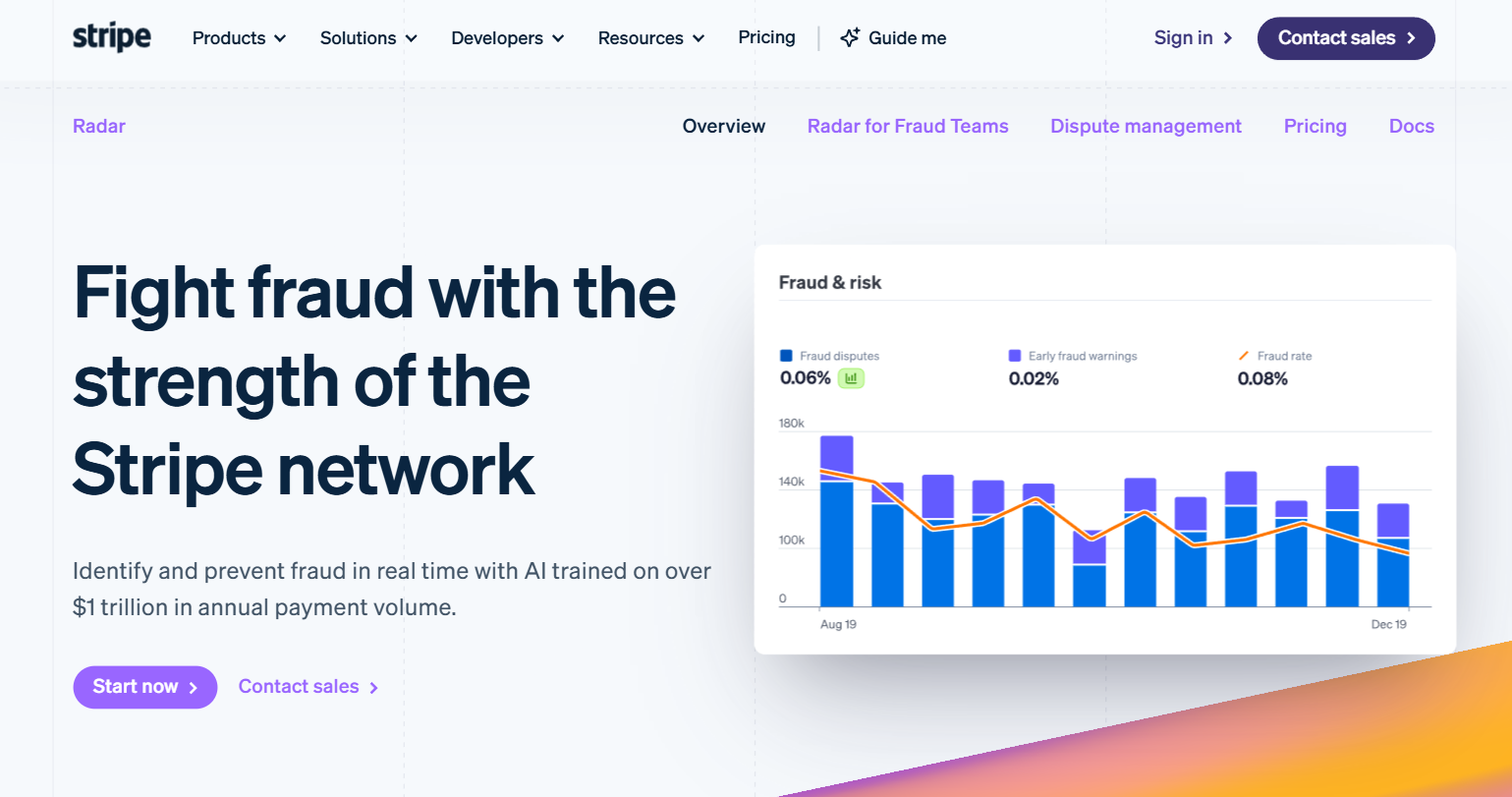
Stripe Radar is an AI-powered fraud prevention solution built directly into the Stripe payment platform. It combines machine learning, behavioral analysis, and customizable risk rules to identify suspicious transactions before they are approved.
Designed for businesses of all sizes, Stripe Radar helps merchants reduce fraud, minimize chargebacks, and improve payment security while maintaining a smooth checkout experience for legitimate customers.
How Stripe Radar Detects Fraud
Unlike traditional fraud prevention systems that rely primarily on fixed rules, Stripe Radar uses machine learning models trained on billions of payment events processed across Stripe’s global network.
Every payment is evaluated in real time using numerous signals, including:
Customer behavior
Device characteristics
IP address and location
Card usage history
Transaction velocity
Previous fraud patterns
Network-wide payment intelligence
Based on this analysis, Radar assigns a risk score to each transaction and determines whether it should be approved, blocked, or sent for manual review.
Because the system continuously learns from new payment data, its fraud detection capabilities improve over time.
Key Security Features
Stripe Radar combines several fraud prevention tools into a single platform.
Its primary features include:
AI-powered fraud detection
Real-time transaction analysis
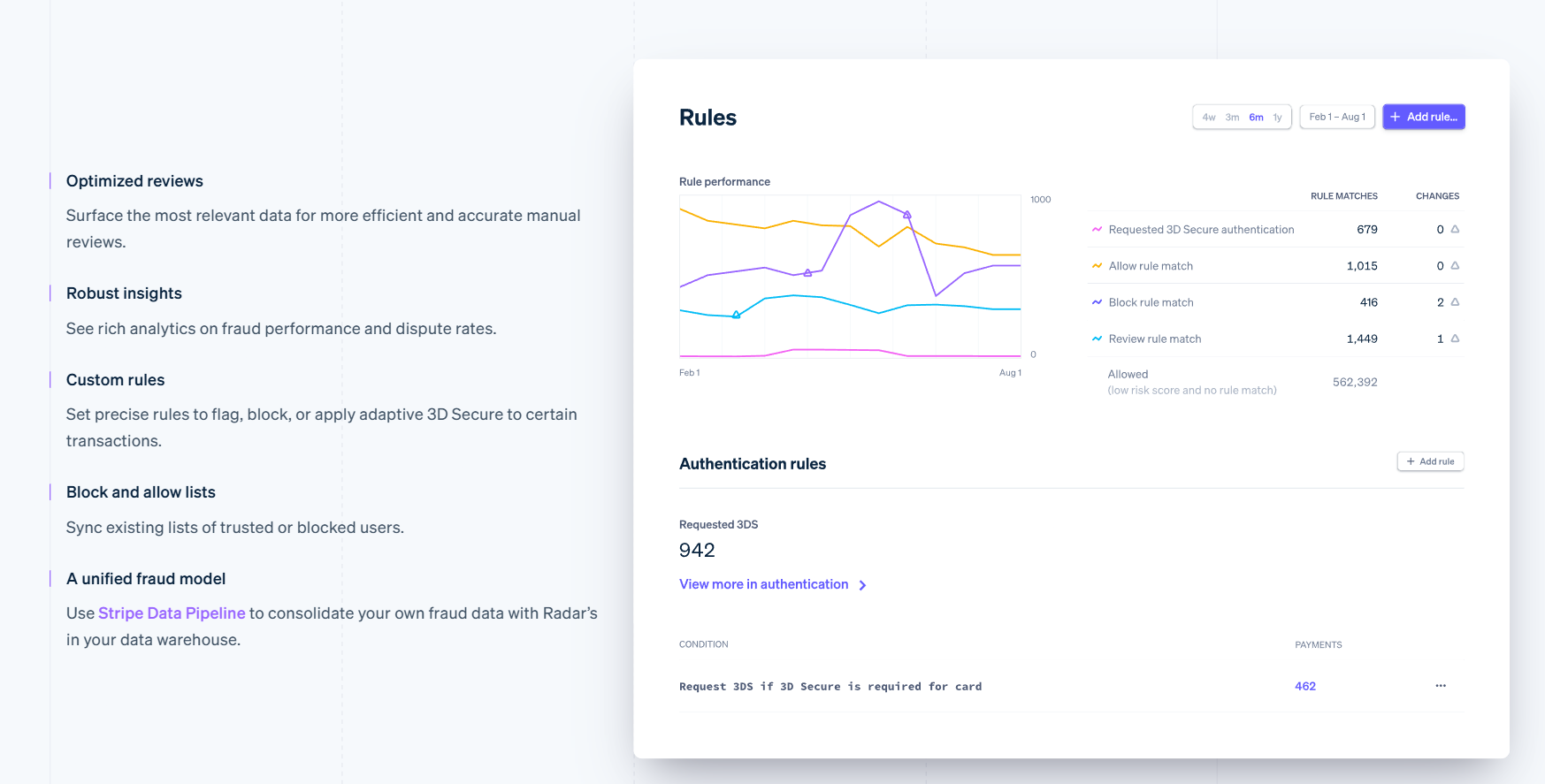
Custom fraud rules
Risk scoring
Card testing protection
Adaptive machine learning
Manual review workflows
Dynamic payment monitoring
Businesses can also create custom rules that automatically block or flag transactions based on specific risk factors relevant to their industry.
Business Benefits
For businesses processing online payments, fraud prevention is about more than blocking unauthorized transactions.
Stripe Radar helps companies:
Reduce fraudulent payments.
Lower chargeback rates.
Decrease manual review workloads.
Improve payment approval rates.
Protect customer accounts.
Detect new fraud patterns quickly.
Scale payment security as transaction volume grows.
Since Radar is built directly into Stripe, businesses can activate fraud protection without integrating a separate security platform.
Potential Limitations
Although Stripe Radar is a powerful fraud detection solution, it should not be viewed as a complete replacement for an organization’s overall security strategy.
Some limitations include:
Available primarily to businesses using Stripe.
No fraud prevention system can block every fraudulent transaction.
False positives may occasionally affect legitimate customers.
Advanced fraud strategies may still require manual investigation.
Some premium capabilities may depend on the Stripe service plan.
Organizations handling sensitive financial data should combine Radar with additional cybersecurity, authentication, and internal risk management controls.
Is Stripe Radar Worth Using?
For businesses already using Stripe Payments, Stripe Radar provides significant value with relatively little implementation effort.
Its AI-driven approach allows merchants to automate much of the fraud detection process while reducing operational costs associated with manual payment reviews.
Businesses processing international payments, subscription billing, marketplace transactions, or high transaction volumes are likely to benefit the most from Radar’s continuously evolving machine learning models.
While it cannot completely eliminate payment fraud, Stripe Radar represents one of the most comprehensive fraud prevention solutions available within the Stripe ecosystem.
Final Verdict
Stripe Radar has established itself as one of the leading AI-powered fraud prevention tools for online payments. By combining machine learning, real-time transaction analysis, and customizable security rules, it helps businesses identify suspicious activity before fraudulent payments are completed.
For companies using Stripe as their payment infrastructure, Radar offers an effective balance between fraud prevention and customer experience. Although no security solution guarantees complete protection, Stripe Radar provides a scalable and intelligent approach to reducing fraud, limiting chargebacks, and strengthening payment security in today’s digital economy.
In a market crowded with newsletters, financial influencers, and AI-generated market commentary, Macro Hive has built a reputation for something increasingly rare: serious macroeconomic research produced by people who have actually managed capital, advised global banks, and navigated financial crises from inside the industry.
Founded in London in 2019, Macro Hive was created with a clear objective—to make institutional-quality macro research accessible beyond the walls of major investment banks and hedge funds. What began as an independent research platform has since evolved into a global financial intelligence business serving over 1,000 institutions across 160 countries.
Following its acquisition by BGC Group in 2025, Macro Hive now finds itself at an important crossroads. The platform has gained access to significantly greater resources and market data infrastructure, but it also faces the challenge of preserving the independence that helped build its reputation.
The question for investors is simple: does Macro Hive still deserve its growing status as one of the most respected independent research platforms in global markets?
The short answer is yes.
Founded by Practitioners, Not Publishers
One of Macro Hive’s strongest advantages is the credibility of its leadership.
CEO and co-founder Bilal Hafeez spent two decades at some of the world’s most influential financial institutions, including JPMorgan, Nomura, and Deutsche Bank, where he held senior research and strategy positions. His career has been focused on global macro strategy, fixed income, currencies, and multi-asset investing.
Co-founder and COO Andrew Simon brings a complementary perspective. Having worked across both buy-side and sell-side firms, including as co-founder of the hedge fund Eschaton Opportunities, Simon contributes practical portfolio-management experience that helps keep the platform focused on actionable investment ideas rather than purely academic analysis.
This institutional pedigree is visible throughout the product. Macro Hive rarely feels like financial media. Instead, it feels much closer to a professional research desk.
What Does Macro Hive Offer?
The platform operates through several subscription tiers, ranging from free content to institutional research services.
The free offering is surprisingly substantial. Visitors can access selected research notes, market commentary, educational articles, podcasts, and newsletters without paying. This makes it possible to evaluate the platform before committing to a subscription.
The flagship product for individuals and professional investors is Macro Hive Prime.
Prime subscribers receive daily macro briefings, research reports, trade ideas, quantitative market models, economic analysis, crypto research, webinar access, and entry into the platform’s active Slack community. The service is designed for investors who need a structured understanding of global markets without spending hours filtering through financial news.
For institutions, Macro Hive Professional offers a significantly more advanced package. Research is integrated directly into Bloomberg workflows, users receive access to model portfolios and tracked performance metrics, and clients can communicate directly with analysts. Advanced quantitative tools, volatility models, and cross-asset analytics are also included.
The separation between Prime and Professional is sensible. Retail investors and independent professionals receive substantial value without paying institutional-level fees, while larger funds gain access to more specialized tools and analyst interaction.
The only notable drawback is pricing transparency. While Prime pricing is publicly available and generally competitive, Professional pricing is only provided upon request, making comparisons with competing providers more difficult.
Research Quality: The Core Strength
Research quality remains Macro Hive’s defining feature.
Unlike many financial publications that rely heavily on opinion-based commentary, Macro Hive tends to publish research built around explicit investment theses, supporting data, and clearly defined risk scenarios.
This approach reflects the backgrounds of its contributors. The platform has assembled a network of more than fifty specialists, many of whom previously worked at institutions such as JPMorgan, Deutsche Bank, Nomura, the International Monetary Fund, and the Federal Reserve Bank of New York.
The result is analysis that generally feels practical rather than theoretical.
For professional investors, this distinction matters. Markets reward actionable insights, not elegant narratives.
Macro Hive consistently focuses on the former.
A Standout Podcast and Educational Ecosystem
The Macro Hive Conversations podcast has become one of the platform’s most valuable assets.
Rather than relying on the same rotation of media commentators, the podcast regularly features former central bankers, leading economists, hedge fund managers, technology executives, and policy experts.
Past guests have included former Bank of England Governor Mervyn King, former IMF Chief Economist Raghuram Rajan, and Financial Times columnist Martin Wolf.
More recently, discussions have expanded into artificial intelligence, quantitative finance, and financial technology, reflecting the evolving interests of institutional investors.
Combined with webinars, newsletters, and educational content, the podcast helps transform Macro Hive from a research provider into a broader learning platform for market professionals.
AI Integration That Goes Beyond Marketing
Few terms are more overused in financial services today than artificial intelligence.
Many firms mention AI in marketing materials without integrating it meaningfully into their actual products. Macro Hive appears to belong to the smaller group of firms using machine learning and language models in ways that genuinely support research production.
The platform uses AI tools for research synthesis, event analysis, sentiment monitoring, and quantitative signal generation. Natural language processing models help analyze large volumes of financial information, while machine learning techniques contribute to volatility forecasting and cross-asset modeling.
Importantly, Macro Hive does not present AI as a replacement for human expertise.
Instead, the platform uses technology to augment analysts, allowing experienced strategists to process information more efficiently while maintaining human judgment where it matters most.
This balanced approach feels considerably more credible than many AI narratives currently circulating in the financial industry.
Market Position and Competitive Landscape
Macro Hive occupies an unusual position within the research market.
Traditional bank research remains unmatched in terms of proprietary data and institutional reach, but access is often limited to major clients and execution relationships.
At the same time, financial media outlets such as Bloomberg, Reuters, and the Financial Times provide excellent news coverage but generally do not offer the structured investment frameworks required by active investors.
Independent research firms such as BCA Research, TS Lombard, and Gavekal offer sophisticated analysis but often at significantly higher price points.
Macro Hive sits between these categories.
It combines institutional-style research, quantitative modeling, educational content, and community engagement into a single platform that remains accessible to smaller funds, independent professionals, and serious private investors.
This positioning is one of the company’s most compelling competitive advantages.
The Impact of the BGC Group Acquisition
The acquisition of Macro Hive by BGC Group in 2025 represents the most important development in the company’s history.
Strategically, the deal makes sense. BGC gains a respected research brand and advanced analytical capabilities, while Macro Hive gains access to institutional-scale market data, technology infrastructure, and capital resources.
The potential upside is significant.
Access to larger data sets could improve Macro Hive’s quantitative models, enhance AI-driven research capabilities, and expand its coverage across rates, foreign exchange, and cross-asset markets.
The principal concern is editorial independence.
One of Macro Hive’s original strengths was its ability to operate free from the conflicts that can affect traditional bank research. Investors will naturally watch closely to ensure that independence survives under corporate ownership.
So far, there is little evidence of any meaningful change in research quality or editorial tone.
Nevertheless, maintaining that independence will remain an important test for the company in the years ahead.
Strengths
Macro Hive excels in several areas:
• Highly credible leadership and contributor network.
• Institutional-quality research presented in an accessible format.
• Strong integration of quantitative models and AI tools.
• Valuable podcast and educational content.
• Active professional community through Slack and events.
• Meaningful free content that allows prospective subscribers to evaluate the service.
Areas for Improvement
The platform is not without limitations.
Professional pricing lacks transparency, making comparisons difficult for smaller institutional buyers.
Independent third-party reviews remain relatively limited, largely because of the platform’s institutional audience.
Coverage is strongest in macro markets, foreign exchange, rates, and public assets, while private markets and alternative investments receive less attention.
Finally, the long-term impact of the BGC acquisition on editorial independence remains an open question.
Macto Hive Final Verdict
Macro Hive has successfully built something that few research providers have managed to achieve: a platform that is respected by institutional investors while remaining accessible to individual professionals.
Its combination of experienced analysts, actionable research, quantitative modeling, educational content, and thoughtful AI integration creates a compelling value proposition in an increasingly crowded market.
For investors seeking serious macroeconomic research without the barriers traditionally associated with institutional analysis, Macro Hive is one of the strongest options currently available.
The BGC acquisition introduces both opportunity and risk, but based on the quality of the platform today, Macro Hive remains one of the most credible and differentiated research providers in the global macro space.
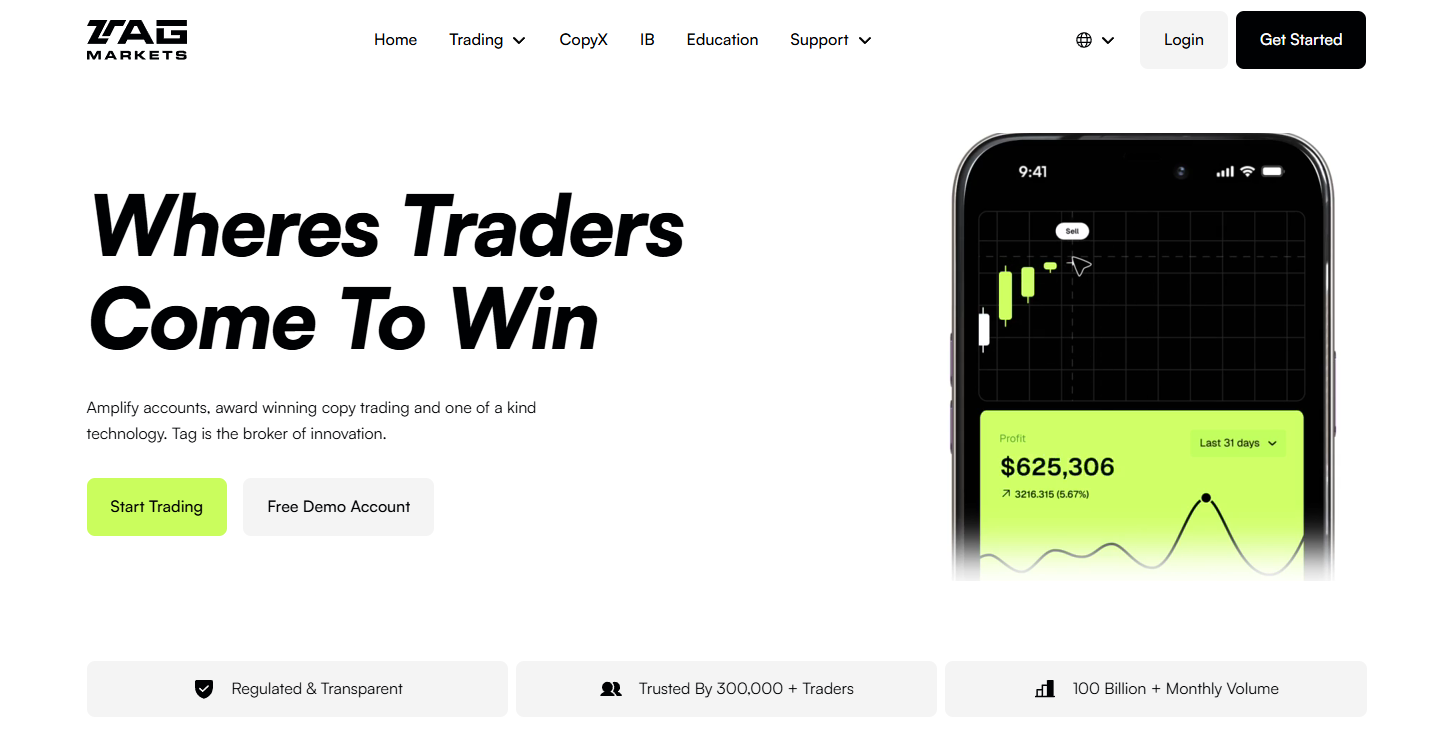
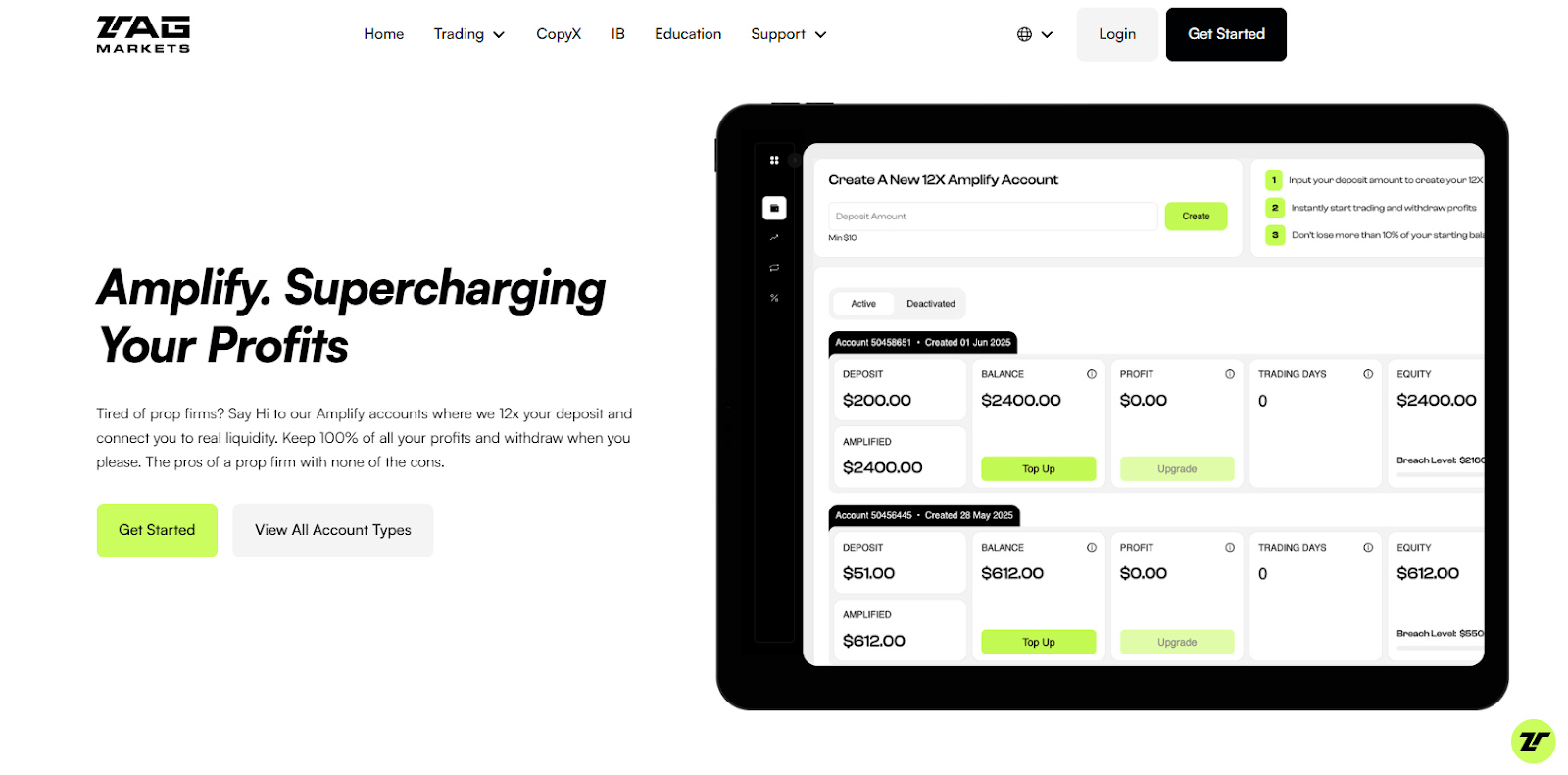
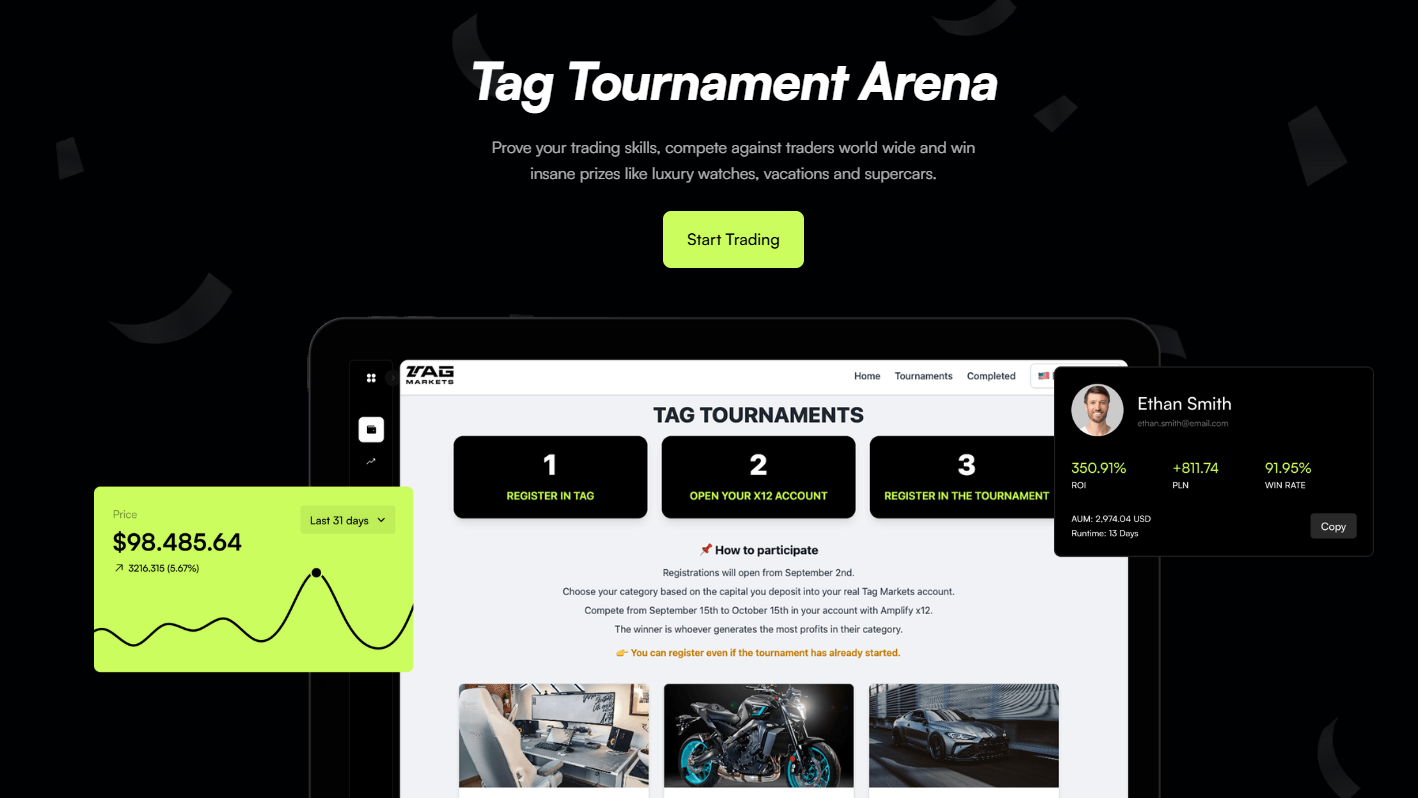
Tag Markets (tagmarkets.com) presents itself as an international broker offering trading in cryptocurrencies, forex, stocks, metals, and CFDs. The company advertises copy trading, managed accounts, personal account managers, and VIP programs. It claims to provide 24/7 support, fast trade execution, and compliance with legal regulations. At first glance, the platform appears professional. However, a closer examination reveals multiple factors that raise serious doubts about the broker’s legitimacy and trustworthiness.
Tag Markets exhibits many warning signs typical of high-risk and potentially fraudulent brokers. Legal compliance claims are unverified, licensing statements are misleading, and the corporate structure is opaque. Independent reviews and client feedback reveal repeated issues with withdrawals and account management. Anyone considering working with Tag Markets should carefully review these findings before investing any funds.
Regulatory Claims
Tag Markets claims to operate under financial regulations and legal standards. In reality, the broker does not have a valid license from any recognized regulatory authority. Tag Markets is not registered or authorized by the FCA, CySEC, ASIC, SEC, or any other reputable global regulator. The company refers to a license previously held by a different company, which was already canceled. Continuing to use this invalid license number is a clear attempt to mislead clients into believing the broker is legally regulated.
European financial authorities have issued warnings about Tag Markets providing services without authorization. This means that clients are not protected under investor compensation schemes, and there is no legal recourse in case of disputes or loss of funds.
Legal Status and Jurisdiction
Tag Markets claims to comply with legislation in Russia and CIS countries. These statements are unverified and misleading. The broker does not have licenses from local regulators in these regions and is not legally recognized as a financial services provider. The company operates primarily through offshore entities in jurisdictions with weak financial oversight. Ownership information, management details, and beneficial owners are not disclosed, and there are no audited financial statements or proof of segregated client accounts. This lack of transparency increases the risk for anyone depositing funds with the broker.
Trading Platforms and Conditions
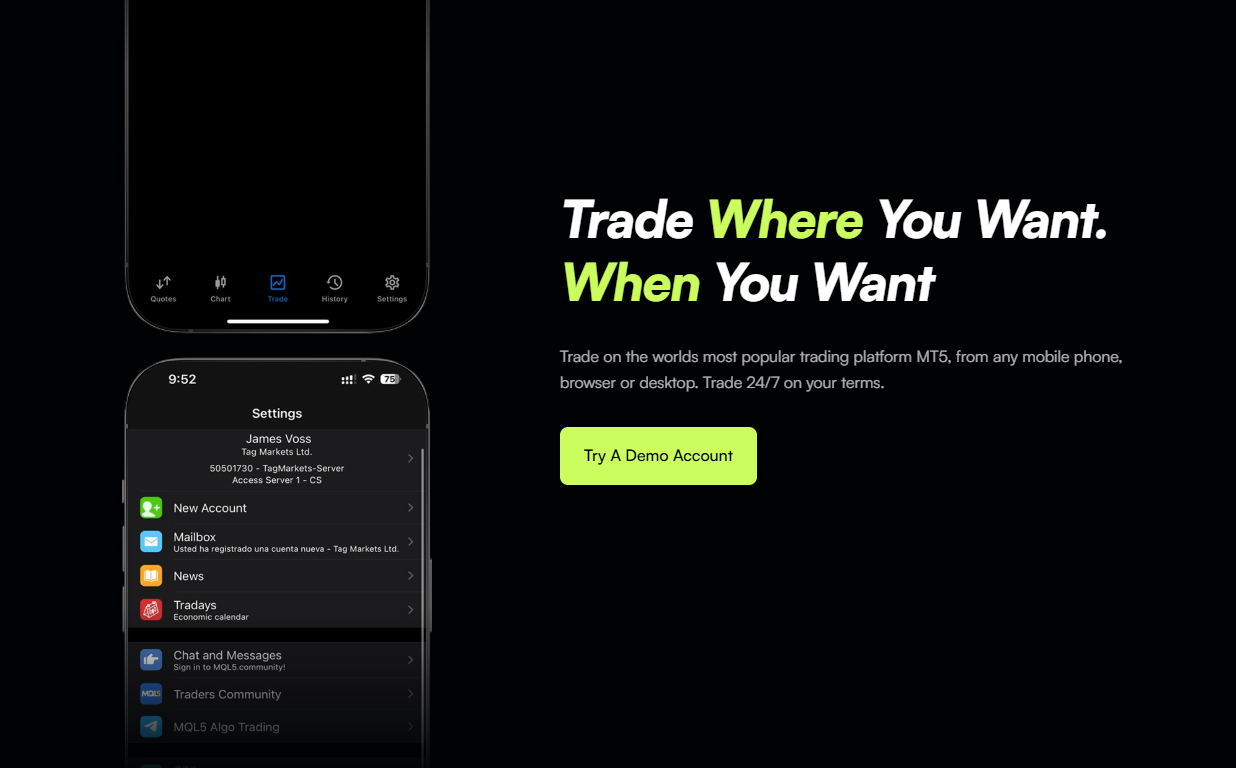
Tag Markets offers access to MetaTrader and its own internal trading platform. The broker promotes fast execution, real-time pricing, and reliable trade processing. However, critical details such as execution type (ECN, STP, or dealing desk), liquidity providers, spreads, and fees are not disclosed. Without this information, traders cannot assess the fairness or true cost of trading.
Numerous client complaints highlight widened spreads, delayed executions, and unusual price movements. Real trading conditions appear to differ significantly from the advertised claims.
Copy Trading and Managed Accounts
Copy trading and managed accounts are presented as easy ways to earn profits without experience. Tag Markets does not provide information about who manages client funds, whether these managers are licensed, or how performance is calculated. Legal agreements covering these services are either missing or incomplete, leaving clients without clear protections or guarantees.
VIP Programs and Account Managers
The broker emphasizes VIP programs and personal account managers to encourage larger deposits. Promises of lower fees, bonuses, and higher returns are used to motivate clients to invest more money. Complaints indicate aggressive marketing tactics, pressure to increase deposits, and misleading profit expectations. After significant deposits are made, the quality of support reportedly decreases, and accountability disappears.
Deposits and Withdrawals
Tag Markets offers multiple deposit and withdrawal methods, including bank cards, cryptocurrencies, wire transfers, and digital wallets. Fees and processing times are described as “individual” or “fast.” In practice, withdrawals are frequently delayed or blocked. Clients report additional verification requests, sudden trading volume requirements, and refusals to release funds. These issues often appear after profits have been made or when clients attempt to withdraw larger amounts. Account blocking and lack of support are recurring themes.
Client Feedback
User feedback shows consistent patterns. Initial experiences may seem positive, with smooth deposits and attentive support. Problems emerge when clients attempt withdrawals, stop depositing, or question account management. Negative reviews include inability to withdraw funds, ignored support requests, and changing terms without notice. Positive reviews rarely confirm successful fund withdrawals and are often limited to interface usability or preliminary interactions with managers.
Marketing and Education
Tag Markets promotes educational videos and analysis to attract beginner traders. While this content may appear helpful, it does not offset the absence of regulation, transparency, or investor protection. Educational resources serve primarily as marketing tools to build trust and encourage deposits.
Conclusion
Tag Markets is an unregulated offshore broker with misleading regulatory claims, an opaque corporate structure, and repeated withdrawal issues. The company’s use of invalid licenses, aggressive marketing, and client complaints strongly indicate a high-risk and potentially fraudulent operation.
Trading or investing with Tag Markets carries a serious risk of total loss of funds. There is no legal protection or compensation available to clients. Only fully licensed, transparent, and regulated brokers should be considered for safe investment and trading activities.
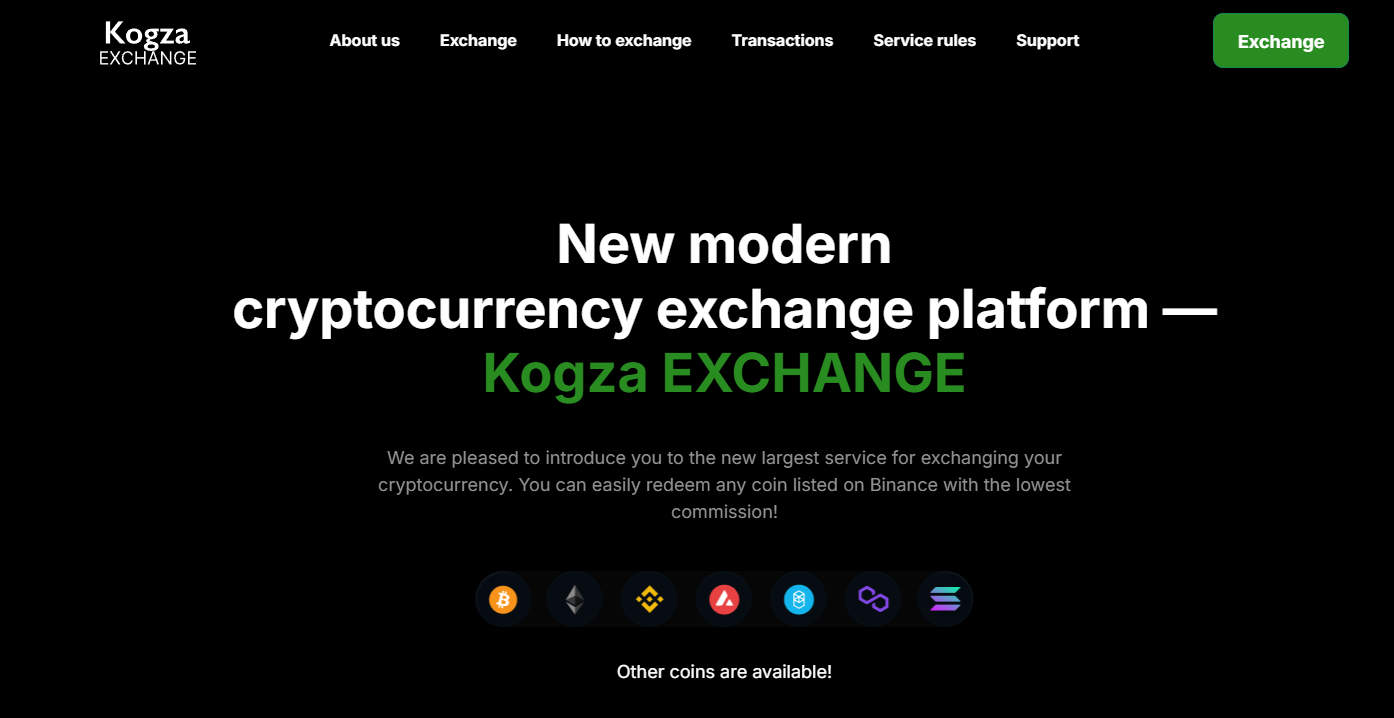
Kogza claims to be a cryptocurrency exchange and broker offering trading services, investment tools, digital wallets, liquidity options, and automated trading. On the surface, these claims may appear attractive. In reality, a close examination of the available information shows that Kogza fails to meet basic standards for a legitimate cryptocurrency platform. The evidence points to significant issues that raise serious concerns about its legitimacy and user safety. This article provides a detailed and candid review of Kogza, focusing on risks, lack of transparency, and strong indications of a scam operation.
Lack of Legal Identity and Regulation
A legitimate exchange or broker must disclose its legal identity, corporate structure, and regulatory status. Kogza does not provide this information. There is no public record of the company’s registration, no mention of its owners or management, and no evidence of licensing from any recognized financial authority. Kogza is not listed in any official regulatory databases. Without clear legal status, users have no protection under financial regulations, no oversight, and no reliable recourse if funds or accounts are compromised. Operating without regulation is a major red flag.
No Verifiable Corporate Information
Kogza does not offer any verifiable company details. There are no names of directors, no official address, and no legally registered entity tied to the website. Transparency about ownership and corporate structure is a baseline expectation for any financial platform. The absence of this information means that users cannot verify who is responsible for the platform, where it is based, or under what legal framework it operates. This level of obscurity is consistent with platforms designed to avoid accountability.
Unsubstantiated Feature Claims
The platform promotes trading services, custodial wallets, liquidity pools, and an automated trading robot. None of these services are supported by detailed documentation, technical explanation, or independent verification. There is no verified list of supported assets, no public fee schedule, no terms of service detailing how trades are executed, and no proof of how the automatic trading feature functions. Making feature claims without transparent execution details is deceptive. Users cannot assess real utility or risk because the underlying mechanics are never disclosed.
Registration Without Meaningful Identity Verification
Kogza allows users to create accounts without mandatory identity verification (KYC). Reliable crypto platforms require KYC to comply with anti‑money‑laundering standards and to protect users. Allowing multiple unverified accounts opens the system to abuse and enables the platform to restrict or block accounts arbitrarily. Lack of KYC can initially seem convenient, but it removes safeguards for users and increases the chance of sudden account restrictions or unexplained freezes.
Custody of Funds Without Proof of Security
Kogza claims to provide built‑in wallets and security features like two‑factor authentication. However, there is no published evidence of secure custody practices, proof of reserves, independent security audits, or on‑chain verification of user funds. Without cold storage, reserve audits, or transparent audits, users cannot know whether their assets are actually stored in real cryptocurrency wallets or merely represented in an internal database. This opaque custody model is a common pattern in fraudulent platforms that do not actually hold user assets.
Withdrawal Problems as Primary Issue
The most consistent negative reports from users involve withdrawal issues. Users report waiting indefinitely for withdrawal processing, receiving no explanation for delays or denials, and being asked to pay additional fees unrelated to standard transaction costs. In some cases, accounts are frozen after deposit and users are blocked from accessing funds. These behaviors—accept deposits quickly and make withdrawal difficult or impossible—are characteristic of scam crypto platforms. Kogza has no clear withdrawal policy, published processing times, or fee transparency.
Customer Support Is Inadequate
Customer support is an essential function for any financial platform. Kogza’s support channels are described as slow, unresponsive, or non‑functional. Many users report getting template responses or no response at all after attempting to resolve account or withdrawal issues. A lack of reliable customer support indicates that the platform is not structured to serve users effectively and lacks accountability mechanisms for dispute resolution.
Negative Reputation and User Reports
Independent user reports consistently describe similar problems: deposits that go in, but withdrawals that never complete; lack of support assistance; and abrupt account restrictions. The consistency of these reports across different forums strengthens the conclusion that the platform operates in a manner harmful to users. When multiple independent accounts describe the same pattern of issues, it cannot be dismissed as isolated user error.
Technical and Transparency Issues
Kogza’s domain registration is obscured, and there is little to no publicly verifiable history of the service. Platforms that deliberately hide domain ownership and operational history are avoiding traceability. Legitimate financial services prioritize transparency and provide clear documentation of their operations, servers, and security infrastructure. The absence of these practices on Kogza’s platform further supports concerns about legitimacy.
Marketing Without Evidence
The language on Kogza’s website focuses on ease and broad capabilities, such as automated trading systems and liquidity options. However, these claims are not backed by technical documentation or verifiable systems. Users are presented with marketing statements rather than factual service guarantees. This tactic is common in scam operations that rely on attracting users with appealing promises but do not deliver real services.
High Risk of Financial Loss
Based on the lack of regulation, absence of transparent corporate information, unverified service claims, chronic withdrawal issues, and negative user experiences, interacting with Kogza carries a high risk of financial loss. Users are likely to encounter arbitrary fees, blocked accounts, and lost deposits. Because there is no legal framework governing Kogza, users have limited options to recover funds once they are transferred.
Conclusion
Kogza does not function like a legitimate cryptocurrency exchange or broker. It fails essential criteria for transparency, accountability, security, and regulatory compliance. The platform’s design, behavior, and user impact are consistent with scam operations that are hostile to user funds. Users should avoid registration, funding, or engagement with Kogza and should seek to recover funds through chargebacks or legal avenues if they have already deposited.
For anyone considering using Kogza, it is strongly advised to conduct independent research, choose licensed and transparent exchanges, and avoid any platform that cannot demonstrate verifiable security, regulation, and accountability. Kogza should be treated as a high‑risk entity with all signs pointing to fraudulent activity.
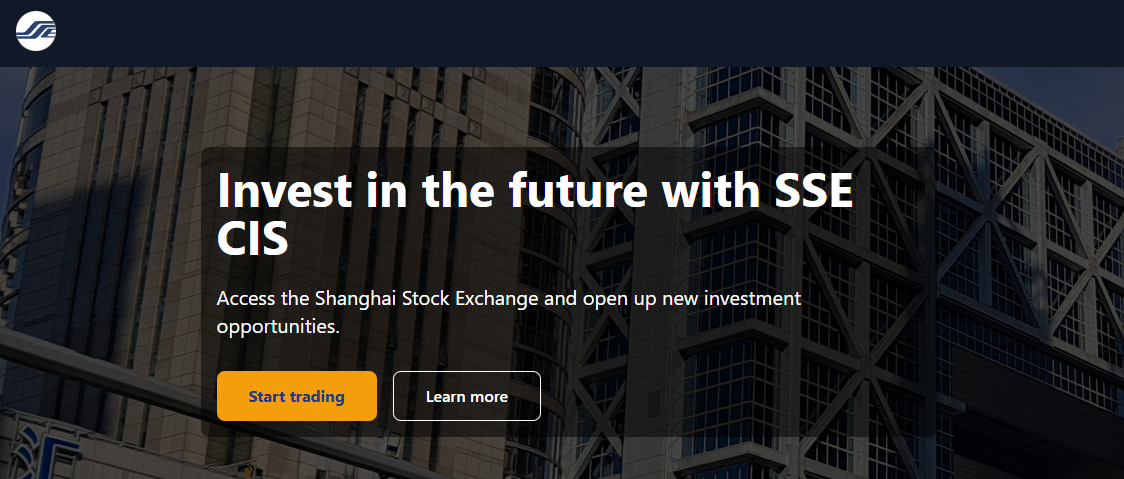
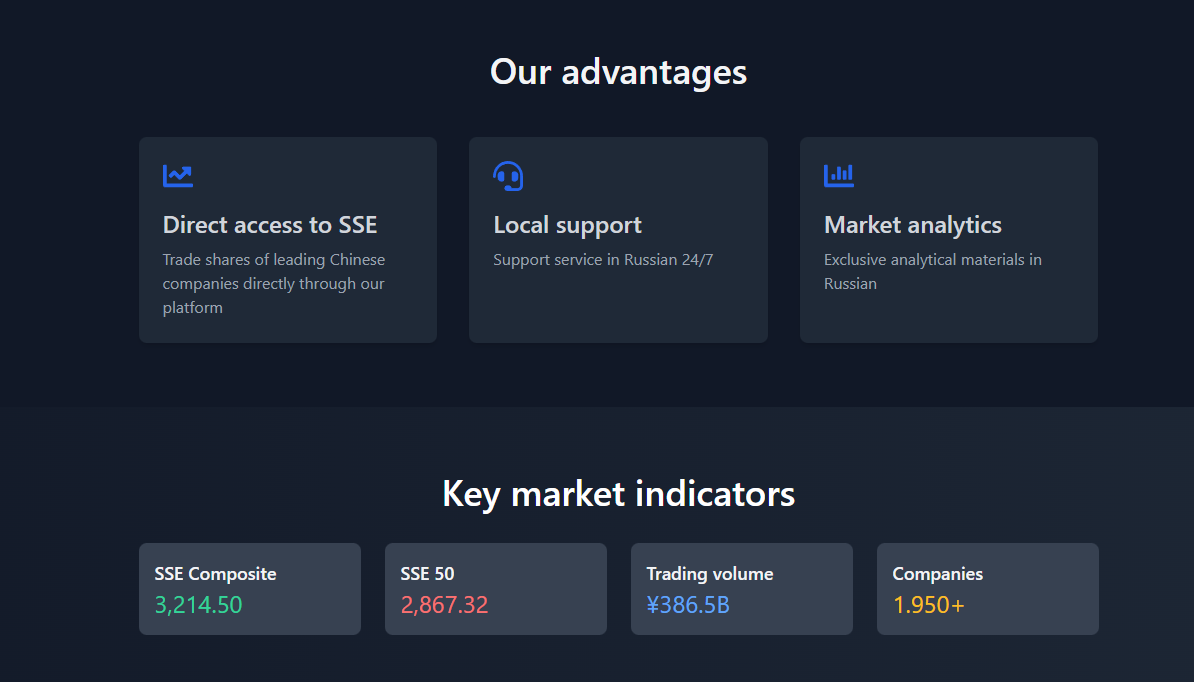
SSE-Trade (sse-trade.com) claims to be an international broker offering trading in cryptocurrencies, stocks, metals, and CFDs. The company promotes services such as personal account managers, VIP programs, copy trading, and managed accounts. While the platform presents itself as a professional trading service, there are multiple red flags that raise serious concerns about its legitimacy.
Potential clients should read this review carefully before considering any engagement, as SSE-Trade lacks transparency, regulatory oversight, and verifiable operational data.
Company Overview
SSE-Trade markets itself as a global brokerage accessible to clients worldwide. It claims to provide fast order execution, educational content, and comprehensive account support. However, the broker does not disclose essential corporate information, including:
Legal entity or registered company name
Country of incorporation
Company registration number
Ownership or management details
The absence of this basic information makes it impossible for clients to verify the broker’s legitimacy or identify who is responsible for handling funds.
Regulatory Status
SSE-Trade states that it operates according to Russian and CIS laws and follows financial regulations. These claims are not backed by any verifiable documents.
There are no licenses listed on the website.
The company is not registered with recognized financial regulators such as FCA, CySEC, ASIC, or FINMA.
No license numbers or regulatory approvals are provided.
Operating without a license means that client funds are unprotected, and there is no recourse if withdrawals are refused or funds are mismanaged.
Trading Instruments
The broker claims to offer trading in multiple markets:
Cryptocurrencies
Stocks
Precious metals
CFDs
Despite these claims, SSE-Trade does not provide essential trading details, including:
Margin requirements
Spreads and commissions
Swap rates
Trading hours
Contract sizes
Without this information, clients cannot evaluate the costs, risks, or actual conditions of trading.
Trading Platforms
SSE-Trade advertises access to MetaTrader and a proprietary web terminal. Critical information is missing:
Whether MetaTrader 4 or MetaTrader 5 is used
Type of order execution (STP, ECN, or dealing desk)
Connectivity to external liquidity providers
Protection against price manipulation
The lack of transparency raises concerns that trading may not occur in real market conditions and could be internally simulated.
Account Types and VIP Programs
The broker promotes a multi-level account system and VIP programs that promise reduced commissions, bonuses, and personal account managers.
However, SSE-Trade does not disclose key details, such as:
Minimum deposits per account type
Real spreads and commission rates
Leverage limits
Bonus terms and withdrawal restrictions
VIP programs in unregulated environments are often used to encourage higher deposits while restricting client withdrawals.
Copy Trading and Managed Accounts
SSE-Trade offers copy trading and managed account services. The broker does not provide:
Verified performance data for traders
Risk disclosures
Legal agreements for account management
Regulatory authorization for investment management
Offering such services without proper licensing significantly increases the risk of mismanagement or misuse of client funds.
Registration and KYC Procedures
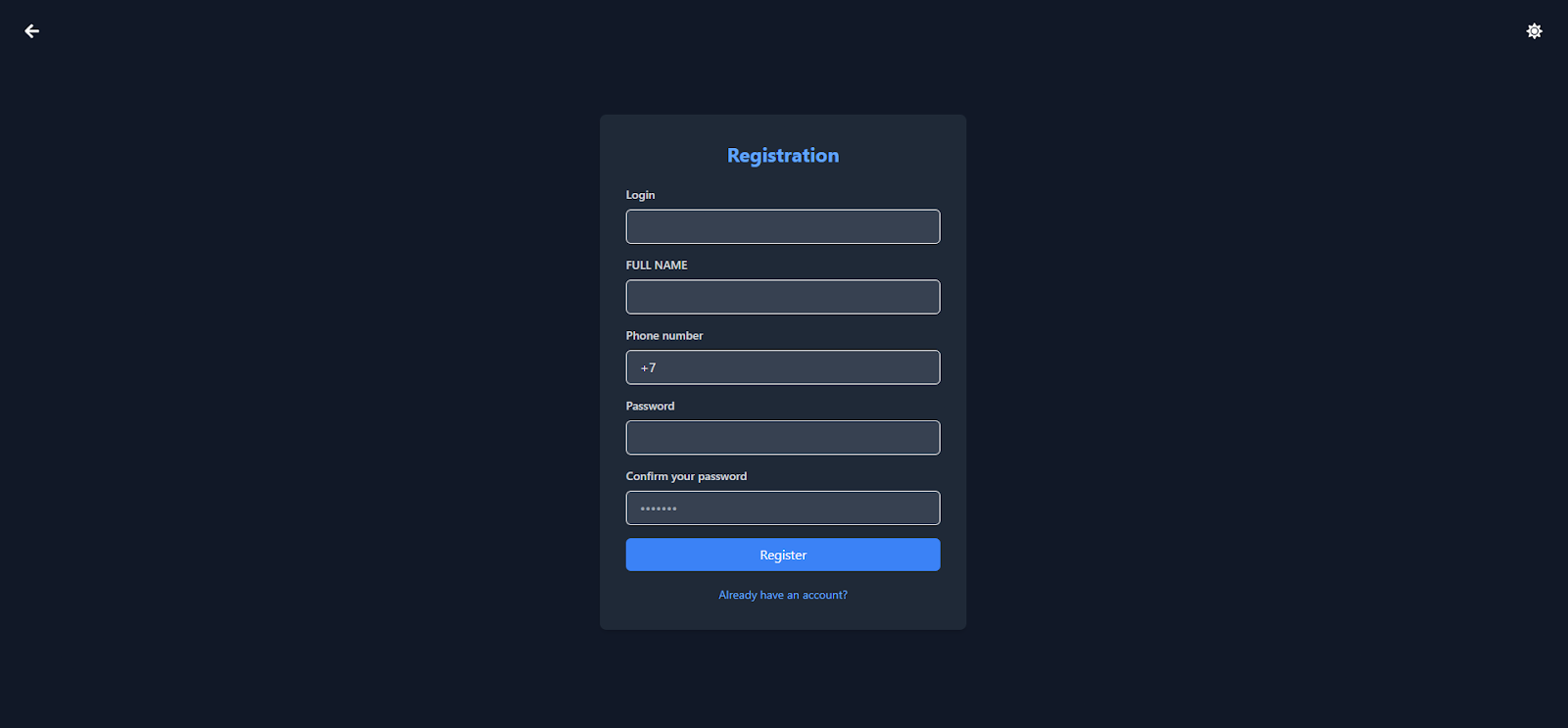
Account registration is described as simple, requiring only an email and phone number. Information regarding KYC and AML compliance is vague or missing.
No clear verification process is explained
No details on how client data is stored or protected
No compliance with international data protection standards
This lack of transparency creates additional risks for clients.
Deposits and Withdrawals
SSE-Trade claims to support:
Cryptocurrencies
VISA and MasterCard
Bank transfers and SWIFT
Google Pay and Apple Pay
Withdrawal procedures are unclear:
Processing times are not specified
Fees are determined individually
Withdrawal limits are not disclosed
Reasons for potential refusals are not listed
The discretionary control over fees and withdrawals represents a major risk for clients.
Customer Support
SSE-Trade states that support is available 24/7 through email, phone, and messaging apps.
Staff qualifications are not disclosed
Accountability for advice or guidance is unclear
In unregulated brokers, personal account managers are often used to pressure clients into depositing more funds instead of providing neutral support.
Reputation and Online Presence
The broker has minimal presence outside its own marketing:
Very few independent reviews exist
No verified client testimonials
No coverage in reputable financial media
The lack of a public track record is a significant red flag for potential clients.
Risks for Clients
Based on the available information, SSE-Trade demonstrates multiple warning signs of a high-risk broker:
Lack of regulatory oversight
Anonymous corporate structure
Unclear trading conditions
Unverified account and VIP programs
Discretionary control over withdrawals
No legal protection for client funds
Conclusion
SSE-Trade presents itself as a full-service global broker, but its operations are opaque, unregulated, and high-risk. The absence of verifiable licenses, corporate information, and transparent trading conditions indicates that funds deposited with the broker may be exposed to significant risk.
Potential clients are strongly advised to avoid depositing substantial funds and thoroughly research alternative, regulated brokers before considering SSE-Trade.
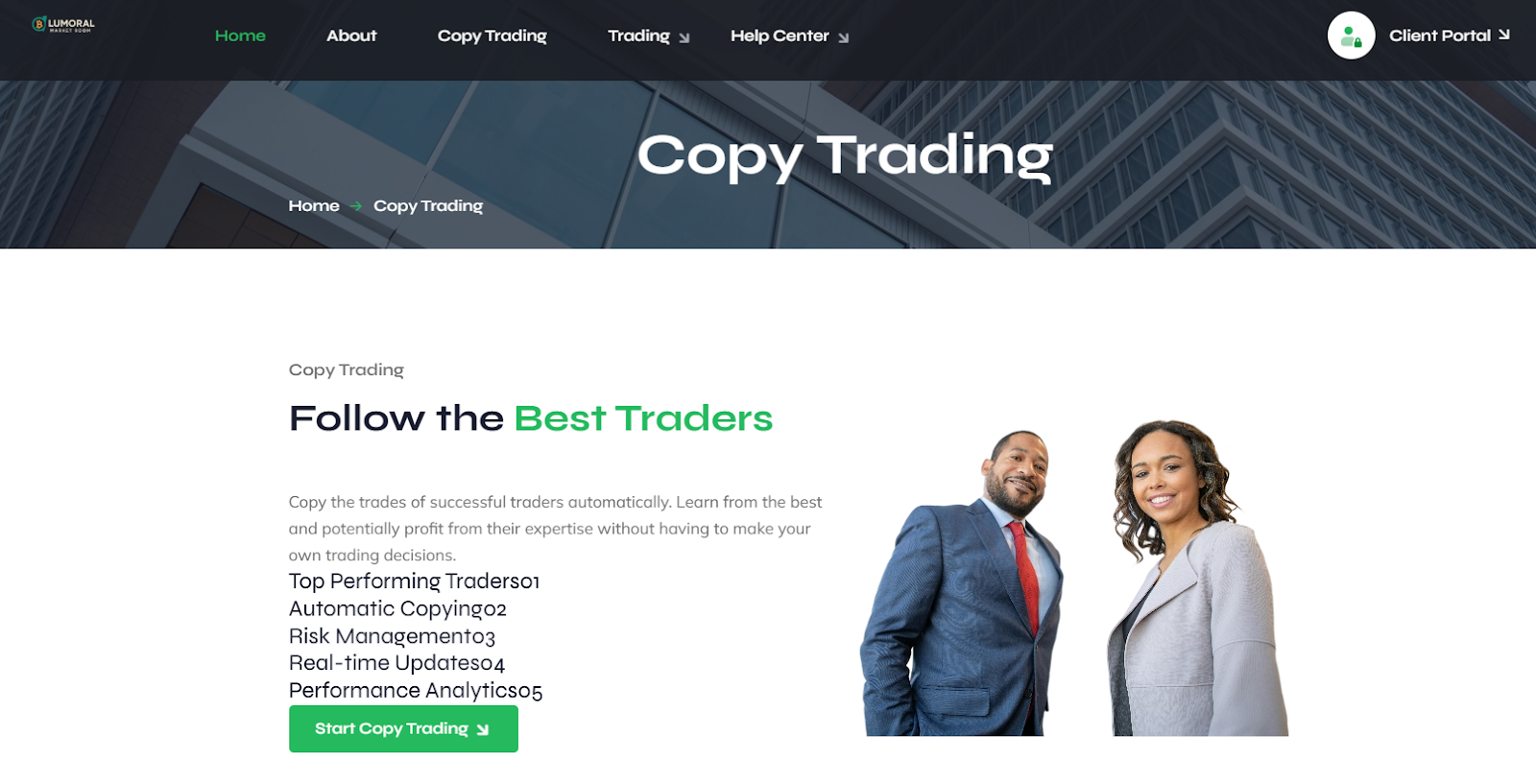
Lumoral Market Room (lumoramarketsroom.com) presents itself as an international brokerage platform offering trading in cryptocurrencies, forex, stocks, metals, and CFDs. The website advertises personal account managers, copy trading, VIP programs, daily analysis, and 24/7 support for clients.
Despite these claims, multiple factors raise serious doubts about the legitimacy of the broker. The lack of verifiable information, missing regulatory oversight, and the structure of the company suggest that Lumoral Market Room operates as a high-risk platform, potentially designed to take client deposits without providing real brokerage services.
Investors should carefully review independent research and user feedback before considering any involvement with this company.
Licensing and Regulation Concerns
Lumoral Market Room does not hold a license from any recognized financial regulator. Searches in the registries of FCA, CySEC, ASIC, SEC, and other reputable authorities show no record of the company.
The website contains vague statements about operating “within legal frameworks” and “following regulatory requirements,” but there are no license numbers, regulator names, or official confirmations. Without proper regulation, there is no oversight, no protection for client funds, and no recourse in the event of disputes.
Lack of Corporate Transparency
The company does not disclose its legal structure or ownership. The website provides no information on the registered company, its country of incorporation, registration number, physical office address, or the identities of owners and directors.
Contact options are limited to email, phone numbers, and messaging apps. The absence of corporate transparency makes it impossible for clients to verify who is responsible for the business or to take legal action if problems arise. This level of opacity is a common feature of fraudulent or shell broker operations.
Domain and Technical Red Flags
The domain lumoramarketsroom.com has a short history, with no long-term presence in financial markets. There is no archival evidence or digital footprint indicating stable or legitimate operations.
While the site uses SSL encryption to protect data transmission, this only secures communication and does not prove legitimacy or regulatory compliance. A newly registered domain, combined with aggressive marketing and limited legal information, is a common indicator of risky or fraudulent online brokers.
Trading Platform and Conditions
The broker claims to provide access to MetaTrader and a proprietary trading terminal. However, essential trading details are missing or unclear:
Execution model is not specified (STP, ECN, or Market Maker)
Spreads and commissions are not transparently disclosed
Leverage and margin requirements are not clearly stated
No policy for order execution or conflicts of interest is provided
Licensed brokers are required to disclose these details and provide risk warnings. The absence of this information suggests potential manipulation of trading results and high risk for clients.
Investment Services Without Verification
The platform offers services such as personal managers, copy trading, managed accounts, VIP status, and daily market analysis.
These services typically require regulatory approval for investment advice and asset management. Lumoral Market Room does not provide any evidence of authorization, auditing, or compliance. This raises the risk that these services are used primarily to encourage larger deposits rather than provide legitimate investment support.
Deposits and Withdrawals
The broker accepts deposits via bank cards, bank transfers, cryptocurrencies, and electronic payment services.
Withdrawal procedures, however, are unclear. There is no detailed information about processing times, fees, or conditions. User reports indicate frequent difficulties withdrawing funds, additional payment requests, and account freezes after withdrawal attempts. These are red flags indicating that clients may lose access to their money.
Client Reviews and Reputation
Independent feedback shows a predominantly negative reputation for Lumoral Market Room. Reported issues include:
Inability to withdraw funds
Pressure from managers to deposit more money
Account suspension after requesting withdrawals
Lack of communication after funds are deposited
Positive reviews are scarce, often generic, and lack verifiable evidence, suggesting that they may not be authentic.
Misleading Marketing and Promises
The broker promotes itself with statements about fast execution, professional support, and profitable trading strategies.
There is no transparency regarding team members, company registration, or audited results. Marketing claims are designed to attract inexperienced traders and create the illusion of a legitimate investment environment, but they are not backed by verifiable evidence.
Risk Assessment
Based on the available evidence, Lumoral Market Room displays multiple indicators of high risk:
No verified regulatory license
Lack of legal and corporate transparency
Newly registered domain with no track record
Opaque trading conditions and unclear fees
Reported withdrawal problems and account blocks
Negative client feedback
These factors collectively indicate that the platform may operate as a pseudo-broker or scam targeting deposits rather than providing legitimate brokerage services.
Conclusion
Lumoral Market Room cannot be considered a safe or regulated broker. The absence of licenses, lack of corporate transparency, and repeated complaints from users indicate a significant risk of financial loss. Investors are strongly advised to avoid this platform and choose brokers with verified regulatory oversight, clear trading terms, and a proven track record.
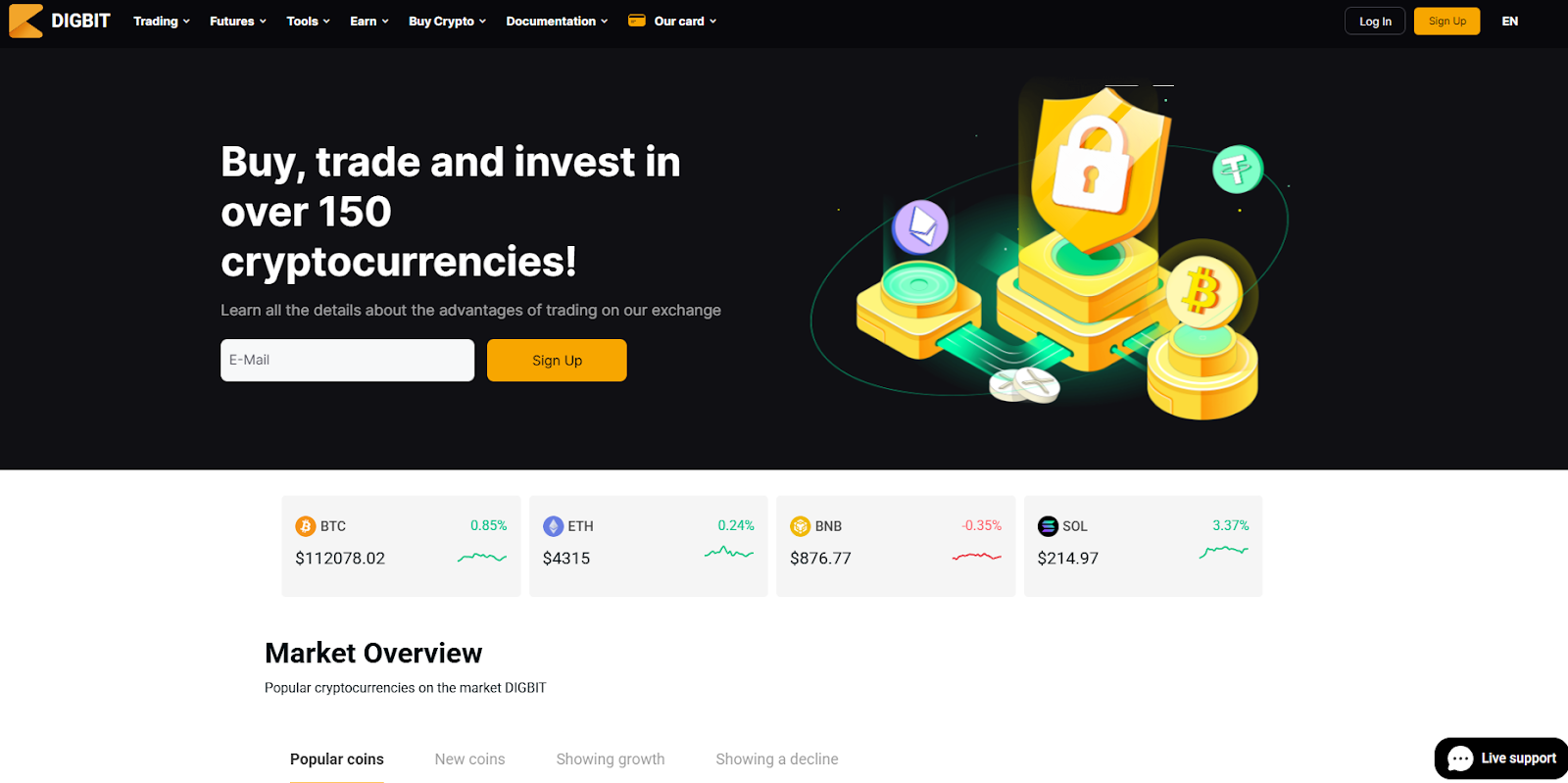
DigBit entered the cryptocurrency market as another digital asset exchange promising modern tools, fast execution, and profitable opportunities. However, a detailed examination reveals a platform with questionable credibility, inconsistent claims, and a high volume of user complaints. This review breaks down what DigBit offers, how it operates, and why traders should be cautious.
What DigBit Claims to Be
DigBit promotes itself as a global crypto exchange designed for both beginners and experienced traders. The platform advertises features such as:
multiple cryptocurrencies
quick order execution
advanced security
smooth trading experience
attractive bonus programs
On the surface, these promises create the impression of a stable and competitive platform. But the closer one looks, the more inconsistencies emerge.
What DigBit Really Looks Like
The first warning signs appear in the structure and content of the website. Many sections are incomplete, several links do not work, and the overall interface resembles a typical template used by short-lived crypto schemes. Despite presenting itself as a long-established exchange, DigBit’s domain was registered recently. There is no evidence supporting the claim of “years of experience.”
Another major concern is the absence of any legal or corporate transparency. DigBit does not provide:
a registered business name
a physical address
regulatory licenses
information about the management team
compliance documents such as AML or KYC policies
A legitimate exchange cannot operate without these elements. DigBit simply avoids providing them.
How the Platform Operates
Trading Environment
Users report that DigBit’s trading interface behaves irregularly. Charts appear manipulated, prices do not match real market data, and balances sometimes increase or decrease without clear reasons. Such behavior strongly suggests that the platform does not conduct real trading on external markets and instead simulates activity internally.
Deposits and Withdrawals
Deposits are processed instantly, but withdrawal attempts become a turning point for many users. Complaints highlight that:
withdrawals remain pending with no explanation
accounts get locked right after a withdrawal request
the system asks for repeated identity checks
support stops responding
In numerous cases, funds simply disappear from the user’s balance.
Extra Charges and Demands
DigBit often requires users to pay additional fees before releasing their funds. These fees include:
“tax fees”
“verification charges”
“unlocking payments”
“insurance fees”
These payments must be sent externally, not deducted from the user’s balance. After paying, users receive new demands, entering an endless cycle with no withdrawal.
User Experiences and Reports
The majority of independent reviews paint a clear picture:
users cannot withdraw money
fake bonuses are used to lure in new deposits
support does not provide real assistance
technical issues appear intentionally created
account balances are altered without user action
no one can verify that real trading occurs
Many reviewers describe DigBit as a controlled environment where all numbers, charts, and balance movements are artificially generated.
Several cybersecurity tools and browsers have started marking DigBit’s website as unsafe. This suggests that the domain or its infrastructure is associated with suspicious activity.
Legal and Regulatory Concerns
A trustworthy cryptocurrency exchange must disclose its operating jurisdiction, licensing body, and legal documentation. DigBit does none of this. The platform operates without regulatory oversight, meaning:
users have no legal protection
there is no authority to file a complaint to
company owners cannot be identified
there is no mechanism to verify financial operations
no audits are conducted
Operating under complete anonymity is a strong indicator that DigBit is not a legitimate financial service.
Key Red Flags
The following issues consistently appear across DigBit’s operations:
no regulatory information
anonymous ownership
unrealistic bonuses and guaranteed profits
trading charts inconsistent with actual markets
blocked withdrawals and disappearing funds
additional fees demanded outside the platform
vague or automated customer support
recently registered domain
warnings from cybersecurity systems
This combination strongly suggests that DigBit follows the model of a high-risk or fraudulent crypto platform.
Risks for Users
Anyone depositing funds into DigBit faces several serious risks:
total loss of funds due to blocked withdrawals
theft of personal data through fake verification
exposure to phishing and malicious redirects
further financial pressure via invented “fees”
inability to take legal action
The platform’s structure is designed in a way that benefits only its operators, not its users.
Conclusion on DigBit
DigBit presents itself as a fully-featured crypto exchange but lacks every critical component that defines a legitimate financial platform. Its opaque structure, artificial trading environment, withdrawal barriers, and widespread negative feedback indicate that DigBit is not a safe place to trade or store funds.
Users should avoid DigBit entirely and treat the platform as a high-risk entity. Those who have already invested should begin recovery procedures immediately and take necessary steps to protect their financial and personal information.
Apexairtek is presented as an international online broker offering access to global financial markets. The company operates through the websites apexairtek.com and apexa-irtek.vip and promotes itself as a modern, client-focused trading platform. However, a closer examination shows that Apexairtek lacks regulatory approval, provides misleading information, and displays multiple signs of a high-risk and potentially fraudulent operation.
This review outlines the essential facts investors should know before engaging with the platform.
Company Overview
What Apexairtek Claims
Apexairtek advertises:
Multi-asset trading
Advanced technology
Fast execution
Low fees
Expert support
Multiple account types
The website portrays the broker as an experienced and reputable institution. But these claims are not supported by verifiable data, licensing, or corporate transparency.
What Apexairtek Really Is
Independent checks show:
No registered legal entity
No license from any financial regulator
No verified office address
No identifiable management or ownership
Newly registered domains with no operational history
The difference between what Apexairtek claims and what can be proven is substantial.
Regulation
No License
Apexairtek does not appear in the registers of:
FCA
ASIC
CySEC
DFSA
FINMA
Any offshore regulatory body
There is no evidence the company holds permission to provide investment services anywhere in the world.
Regulatory Warnings
The platform has already been listed by the Central Bank of Russia as an entity showing signs of illegal financial activity. This is a serious alert for potential investors.
Website and Corporate Information
False Addresses
Apexairtek lists office locations in major financial centers. Checks show the addresses either do not exist or do not correspond to any company named Apexairtek. No business registration is linked to these locations.
Hidden Ownership
There is no information about the company’s owners, management, compliance officers, or auditors. No corporate registration number is provided.
Misleading Company History
The broker claims to have long experience in financial markets, yet domain records show that the website appeared recently and has no historical presence or track record.
Trading Platform and Tools
Unverified Technology
The company states that it uses a proprietary trading system. However:
No documentation is available
No third-party audits exist
The platform’s functionality cannot be verified
Simulated Trading
Reports from users indicate that the trading interface displays artificial results. Charts and price data do not consistently match real market conditions, suggesting the system operates as a simulation rather than a real trading terminal.
Client Accounts and Deposits
Account Types
Apexairtek offers several account tiers with rising minimum deposits. Higher tiers require large sums and promise access to additional tools and markets.
These features are not independently verified.
Deposit Methods
Deposits are typically made through:
Bank transfers
Credit cards
Digital payment systems
Once funds are deposited, clients lose control over them, as withdrawal requests are systematically rejected or delayed.
Withdrawals
Blocked Withdrawals
One of the most common issues reported by clients is the inability to withdraw funds. Typical scenarios include:
Endless verification procedures
Sudden fees or taxes
Requests for additional deposits
Claims of “technical errors”
Account freezes without explanation
There is no confirmed case of a successful withdrawal.
Customer Support
Unreliable Service
Apexairtek promotes 24/7 support, but in practice:
Emails remain unanswered
Phone calls stop after deposits are made
“Personal managers” disappear once clients request withdrawals
The communication pattern matches that of unregulated high-risk brokers.
Red Flags
Key Warning Signs
No regulation
No legal registration
Newly created domains
False office addresses
Anonymous ownership
Unrealistic profit claims
Aggressive deposit pressure
Withdrawal obstruction
Identical structure to known scam brokers
These elements collectively indicate a high probability of fraudulent activity.
What Clients Report
Common Complaints
Users consistently describe:
Manipulated trading data
Constant encouragement to deposit more
Blocking of accounts
No access to funds
False promises of profit
Threats of additional fees
The complaints follow a uniform pattern, further supporting concerns about the broker’s integrity.
Risk Assessment
Why Apexairtek Is Dangerous
Apexairtek operates without regulation, transparency, or accountability. The platform shows the operational structure of fraudulent brokers that aim to collect deposits without providing legitimate financial services. The lack of verifiable information, combined with the consistent pattern of withdrawal refusal, makes the company extremely high-risk for investors.
Conclusion on broker
Apexairtek is not a regulated broker, does not disclose its legal identity, and does not demonstrate the infrastructure required to provide real trading services. Evidence suggests that the platform functions as a deceptive investment scheme, not as a legitimate financial institution. Investors should avoid Apexairtek entirely. Any funds deposited with this platform are at serious risk of permanent loss.
Ayoorvan, operating through ayoorvan.com and ayr-van.ltd, presents itself as a modern and global trading platform. At first glance, the websites look polished, the language is confident, and the company claims to offer secure access to financial markets. However, once the details are examined closely, the picture changes. The platform shows multiple signs of an unregulated and high-risk operation.
This review outlines the key elements that define Ayoorvan’s model and explains why the broker raises serious concerns.
About the Company
Ayoorvan does not provide reliable information about its legal status. The website contains general statements about being an “international broker,” but no verified corporate details are available.
The problems begin with basic transparency:
no registered company name listed,
no corporate registration number,
no verified physical office address,
no publicly known owners or executives.
Every reputable broker discloses this information openly. The absence of such essential data is a major warning sign for anyone considering using the platform.
Regulation Claims
Ayoorvan repeatedly mentions licensing and international regulation. These claims do not stand up to verification.
The broker is not licensed by:
FCA in the UK,
CySEC in Cyprus,
ASIC in Australia,
FINMA in Switzerland,
DFSA in the UAE,
or any recognized authority.
Searches across multiple regulatory databases confirm that Ayoorvan is not authorized to provide financial services in any jurisdiction. The so-called “licenses” shown on the website are generic, lack identification numbers, and cannot be validated.
For investors, this means there are no safeguards, no oversight, and no legal protection.
How Ayoorvan Attracts Clients
The acquisition strategy of Ayoorvan relies on aggressive and persuasive communication.
Clients report the same pattern:
Registration on the website.
Immediate calls from “account managers.”
Pressure to deposit funds quickly.
Promises of guaranteed profit and personal market guidance.
The tone of communication is urgent, emotional, and designed to create the feeling that opportunities must be seized instantly.
These methods are typical of unregulated brokers, where the real priority is securing deposits rather than providing financial services.
The Trading Platform
Ayoorvan uses a platform that looks modern but operates as an internal simulation rather than a connection to real markets.
Several indicators confirm this:
market prices do not match actual market data,
order execution is instant regardless of volatility,
balances grow at an unrealistic and consistent rate,
there is no evidence of any liquidity provider or exchange connection,
profits appear manufactured to encourage additional deposits.
Because the environment is closed and controlled by the broker, all trading activity shown to the user can be manipulated. The platform does not reflect real-world financial markets.
Deposits and Withdrawals
Deposits are simple and encouraged at every stage. Withdrawals, however, present substantial issues.
Clients typically face:
unexplained delays,
new “fees” introduced after the withdrawal request,
demands for insurance, taxes, or verification charges,
refusal to release funds without additional deposits,
account closure or communication cut-off.
No legitimate broker asks clients to pay new fees before receiving their own money. These practices align closely with common patterns used in financial scam operations.
Customer Experience
Feedback from traders across independent review sites is overwhelmingly negative. Several themes repeat consistently:
persistent phone calls,
unrealistic promises,
artificial account growth,
blocked access to funds,
lack of communication after requests for withdrawal,
accounts frozen without explanation.
Some users note that Ayoorvan resembles a number of other suspicious platforms using identical website structures and identical communication styles. This suggests that Ayoorvan could be part of a larger network of short-term, high-risk broker clones.
Safety Assessment
Ayoorvan cannot be considered safe for trading or investing. The platform demonstrates multiple risk factors:
no regulation,
no transparent legal information,
simulated trading environment,
aggressive deposit-focused sales tactics,
systematic refusal to process withdrawals,
a pattern consistent with known fraudulent broker operations.
Investors choosing to engage with the platform face a significant risk of losing all deposited funds.
Conclusion on broker
Ayoorvan presents itself as a legitimate trading service, but its structure, behavior, and lack of regulation indicate otherwise. The platform is not transparent, does not provide real access to financial markets, and offers no meaningful protection for its users.
Based on all available data, the safest and most responsible decision is to avoid Ayoorvan entirely. Investors should work only with licensed, verified, and regulated brokers.
Wiqobyg PQ is an online trading company presenting itself as an international broker. Behind the polished website and impressive claims, however, the platform reveals numerous warning signs that point to an unregulated and unsafe operation. This review examines the broker’s background, regulatory status, platform integrity, client experience, and overall risk level.
Company Overview
Wiqobyg PQ advertises access to global markets, modern technology, and expert support. The website highlights:
multi-asset trading,
personal account managers,
fast execution,
investor-friendly conditions.
Although the marketing materials appear convincing, the company fails to provide verifiable information about its ownership, registration, or legitimate business activity. The more closely one examines Wiqobyg PQ, the more inconsistencies arise.
Regulation
Regulation is the primary protection for anyone trading financial instruments. Legitimate brokers operate under licenses from well-known supervisory authorities. Wiqobyg PQ does not.
No License
Searches across international regulatory databases confirm that Wiqobyg PQ is not regulated by:
CySEC
FCA
ASIC
BaFin
FINRA
Central Bank of Russia
any offshore regulator with recognized oversight
The company provides no license numbers, no regulatory documents, and no evidence of authorization to offer brokerage services.
Official Warnings
The Central Bank of Russia has publicly listed Wiqobyg PQ as a company conducting illegal activities in the financial sector. Such classification indicates that clients have no legal protection and no recourse in case of disputes or financial loss.
False Registration Details
The broker claims to operate from Cyprus, yet the address provided leads to a residential area. The listed phone number is a generic mobile number with no corporate attribution. This strongly suggests that the company is misrepresenting its physical presence.
Website and Domains
Wiqobyg PQ uses several domains, including wi-qobyg.pro, wiqb-pq.ltd, and wiqobygpq.com. The domain records show:
recent registration dates,
hidden ownership,
multiple changes in domain history,
lack of archived evidence of long-term activity.
Constant domain rotation is one of the most common tactics used by unregulated brokers attempting to escape regulatory action and consumer complaints.
Trading Platform
Wiqobyg PQ claims to provide a modern trading platform, but the technical details are unclear.
No Verified Software
The company does not disclose:
the name of the platform,
the underlying technology,
liquidity providers,
server information,
order execution procedures.
The interface resembles simulated trading software rather than a genuine connection to financial markets.
Lack of Documentation
Key documents typically available with regulated brokers — client agreements, risk disclosures, margin policies — are either missing or provided in generic, non-binding form.
How the Scheme Works
Wiqobyg PQ follows a pattern commonly seen among fraudulent brokers. Reports and user experiences indicate a clear sequence of manipulative tactics.
Attracting New Clients
The company uses:
aggressive marketing,
unsolicited phone calls,
exaggerated profit claims,
fabricated testimonials.
The goal is to persuade clients to make an initial deposit, usually a small amount intended to lower psychological resistance.
Creating the Illusion of Profit
Once a client deposits funds, the platform begins to display rapid account growth. This is not actual trading performance but a controlled representation designed to build trust and push the investor toward additional deposits.
Increasing Pressure
As the balance “grows,” assigned managers encourage larger investments. They use urgency, emotional triggers, and fabricated market insights to persuade clients to escalate their deposits.
Blocking Withdrawals
When a client attempts to withdraw money, a series of obstacles appears:
service fees,
“taxes,”
upgraded account requirements,
repeated identity verification requests.
These barriers never lead to a successful withdrawal.
Final Step
If the client refuses to continue depositing money, the account is disabled and all communication stops. Support becomes unreachable, and the funds are lost.
Client Reports
Numerous clients describe similar experiences:
sudden account freezes,
unexpected fees,
complete denial of withdrawals,
disappearance of support representatives,
hostile or manipulative behavior from “analysts.”
Losses range from small deposits to significant amounts accumulated through multiple rounds of pressure.
Positive reviews published online appear coordinated and lack credible details. Their repetitive style suggests they are produced by marketing teams hired by the scammers.
Risks
Wiqobyg PQ poses several clear risks:
no regulatory oversight,
no compliance with investor protection laws,
high likelihood of loss of all deposited funds,
misleading information about company operations,
falsified trading environment,
unverified and unsafe platform structure,
no transparency regarding ownership or management.
For these reasons, Wiqobyg PQ cannot be considered a legitimate or trustworthy broker under any circumstances.
Conclusion on broker
Wiqobyg PQ is not a regulated brokerage firm but an unlicensed and deceptive operation built to exploit investors. Its practices include false advertising, fake corporate data, simulated trading, aggressive pressure tactics, and systematic denial of withdrawals.
No investor should deposit money with Wiqobyg PQ or engage with any of its associated websites. The platform provides no safeguards, no legitimacy, and no transparency. Choosing this broker places users at immediate and irreversible financial risk.














Comments
Senquar Analytics Review
Protavex Review
Protavex Review
Senquar Analytics Review
Senquar Analytics Review